
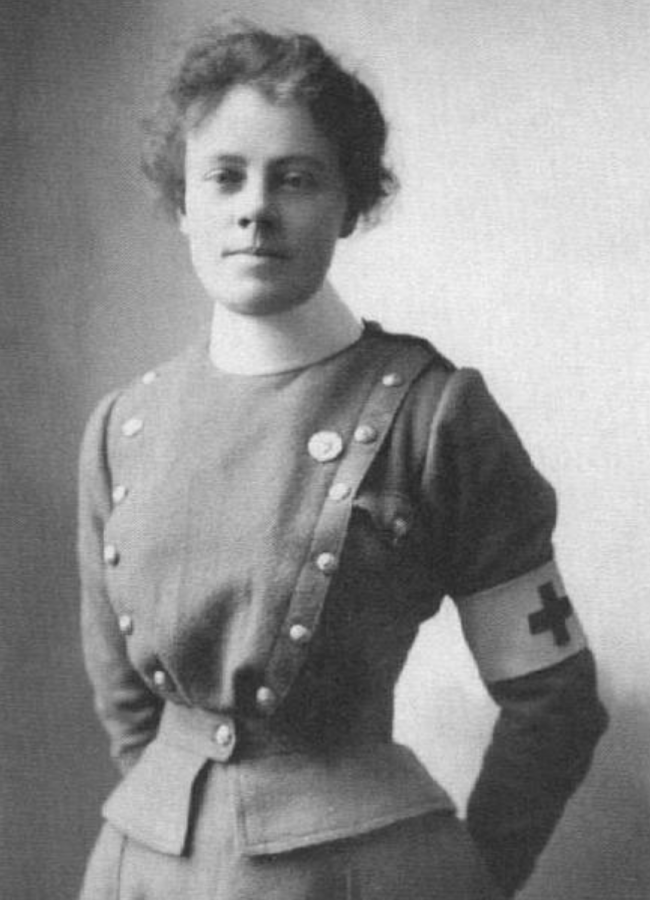
Margaret Macdonald
In times of war, military success is often determined by one nation’s ability to preserve fighting strength. While there are many ways in which maintaining combat power can be achieved, nurses have proved crucial in aiding the task. In the late nineteenth and early twentieth centuries, Canada’s own trailblazer, Margaret Macdonald, helped the advancement of the structured, professional nurse known today.
On 26 February 1873, Margaret St Clothilde Elizabeth Macdonald was born in Bailey’s Brook, Nova Scotia, to Donald St Daniel (D. D.) Macdonald and Mary Elizabeth Chisholm. The couple had eleven children; Margaret was third and one of the nine Macdonald kids to reach adulthood. By the time she was born, Margaret’s father, D. D., was forty-six years of age and had established himself as a prosperous business owner in the community. In contrast, her mother, Mary, was much younger; twenty-three years old when she gave birth to Margaret. Despite her youth, Mary was a strong and independent woman of unwavering Catholic faith, qualities Margaret inherited and would later emulate. More importantly, however, was Mary’s deep conviction that education was of equal value for her daughters as much as her sons. Thus, the wealth of her father and the ambition of her mother allowed Margaret to receive a comprehensive education – an uncommon opportunity for young women of the time.
In Pitcou, Nova Scotia (nearly 50 kilometres from Bailey’s Brook), Margaret completed her primary education at Stella Maris Convent School. She later moved further from her home, into Halifax, where she finished her pre-secondary studies at Mount St. Vincent Academy. There, Margaret was taught by the Sisters of the Charity and became enthralled in nursing, particularly in the military. She would learn about the history of the Sisters as well as figures such as Florence Nightingale and her work at Crimea in the 1850s. It was at Mount St. Vincent Academy where Margaret found her calling. Years later, in 1918, Margaret became the recipient of the Florence Nightingale Medal, having adopted the legacy of one of her idols.
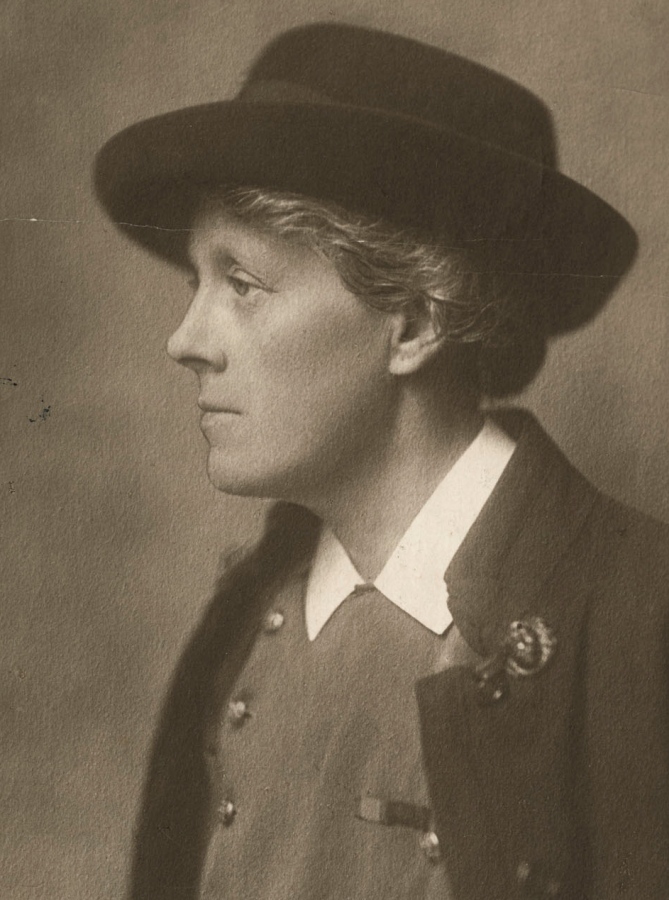
In 1893, Margaret left Canada and moved to New York where she enrolled at the Charity Hospital (the New York City Hospital). It was at this institution where Margaret was formally trained as a qualified nurse. She was eager to learn and dedicated to mastering her craft. Two years later in 1895, Margaret graduated as a star pupil ready to storm her field.
It was not long before Margaret began helping wounded and/or ill-ridden soldiers. In August 1898, she became employed at Camp Wikoff (Montauk Point, New York) where she treated returning soldiers from the Spanish-American War. Margaret stayed a month before she served the USS Relief hospital ship in September, aiding the transportation of American soldiers from Cuba. However, there is speculation as to whether Margaret was actually aboard the Relief. Her father, D. D., claimed she did, but Margaret herself never listed Relief as one of her experiences. Nevertheless, by 1900, Margaret embarked on her next journey as she shipped off from Halifax aboard the Laurentian and headed towards South Africa.
On board Laurentian in 1900 was Margaret as well as three other nurses who formed the second contingent of Canadian nurses that would serve in the Second South African War (Boer War). The first contingent left a year earlier in 1899 and included other notable nurses such as Georgina Fane Pope. Margaret arrived at Cape Town in mid-February 1900 and was immediately sent to various British hospitals spread throughout South Africa. She spent most of her time at care facilities in Rondebosch, Kimberly, Bloemfontein, and Pretoria treating soldiers who suffered from typhoid and dysentery – diseases exacerbated by the war. In addition to having served one full tour (roughly a year), Margaret returned to South Africa in 1902 for a half tour (approximately six months), where she served with Georgina Pope. During her two trips, she not only became one of the first women to receive a military commission, but she also became closely acquainted with John McCrae, the author of Flanders Fields. While in South Africa, McCrae often wrote letters to Margaret and would address her as “Her Ladyship in Khaki, Fair.”
After Margaret returned from the war, she briefly took a position in Panama, having nursed ill or wounded workers involved in the construction of the Panama Canal. She worked in Panama from 1904-1905 before she contracted malaria. Once recovered, she retuned to Canada. In 1906, Margaret joined Georgina Pope as the two became the first full-time nurses of the Permanent Active Militia Army Medical Corps, where she remained until the First World War.
As war began in 1914, Margaret was assigned to train 100 nursing sisters that would join the first contingent of Canadian soldiers as part of the Canadian Expeditionary Force. On 4 November 1914, after she arrived at England, Margaret earned the role as Matron-in-Chief of the Canadian Nursing Service. Over the course of the First World War, Margaret oversaw all Canadian military nurses serving overseas. She ensured every nurse was properly trained and possessed a comprehensive understanding of their field – having increased standards and professionalised the occupation. Along with her title of Matron-in-Chief, Margaret was also promoted to the rank of major. Not only did she become the highest-ranking female officer of the time, but she was the first woman to achieve the rank of major in the British Empire.
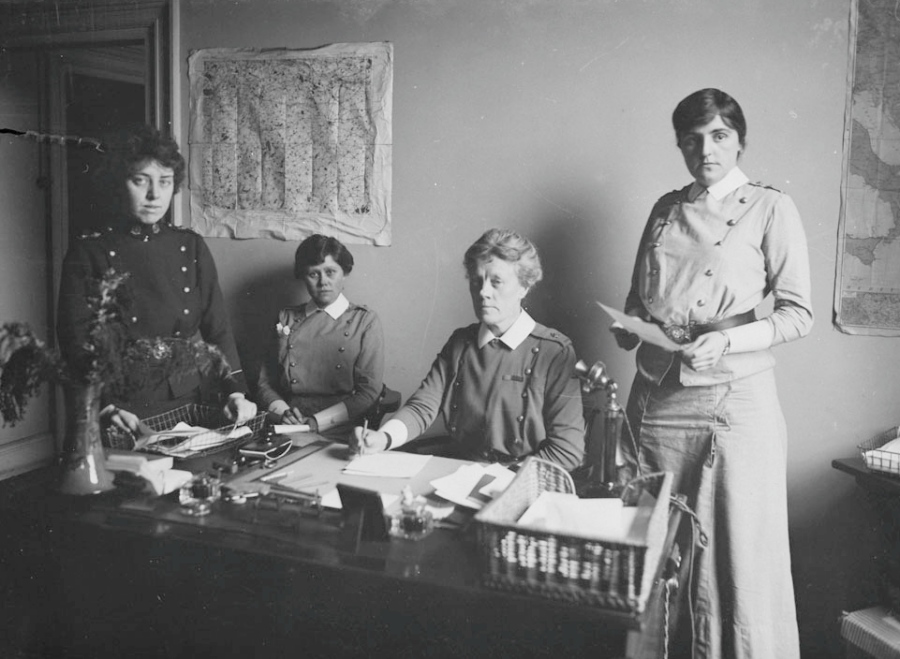
In 1919, Margaret returned to Canada and was named head of the Nursing Service of the Canadian Army Medical Corps. During her tenure, she facilitated the reorganisation of the medical corps into the Royal Canadian Army Medical Corps. In 1920, Margaret retired and spent the rest of her life in Bailey’s Brook. She never married, nor had children of her own, but Margaret spent the remaining years of her life always close with her siblings as well as her nieces and nephews. On 7 September 1948, Margaret died peacefully at the age of 75 and was buried in a small cemetery at Mount St. Mary’s, next to her father and mother.
According to Macdonald’s biographer, Susan Mann, Margaret chased “as many wars as she could over her lifetime.” (Mann, 29). It was Margaret’s ambition, determination, and genuine need to help people that allowed her to become a pioneer of modern military nurses. Just as she once admired Florence Nightingale, there are nurses today who hope to follow in the footsteps of Margaret Macdonald.
Main Image: Margaret Macdonald, “Her Ladyship in Khaki, Fair.” (Credit: Susan Mann/Waldren Studios Photographic Collection, PC2, box 123, folder 107, Dalhousie University Archives)
Suggested Reading: Margaret Macdonald: Imperial Daughter by Susan Mann
Sources
Bruin, Tabitha de. “Margaret C. Macdonald.” The Canadian Encyclopedia, 2026. https://thecanadianencyclopedia.ca/en/article/margaret-c-macdonald
Mann, Susan. “Macdonald, Margaret Clotilde (Clothilde).” Dictionary of Canadian Biography, 2024. https://www.biographi.ca/en/bio/macdonald_margaret_clotilde_17E.html
Mann, Susan. Margaret Macdonald: Imperial Daughter. McGill-Queen’s University Press, 2005.