
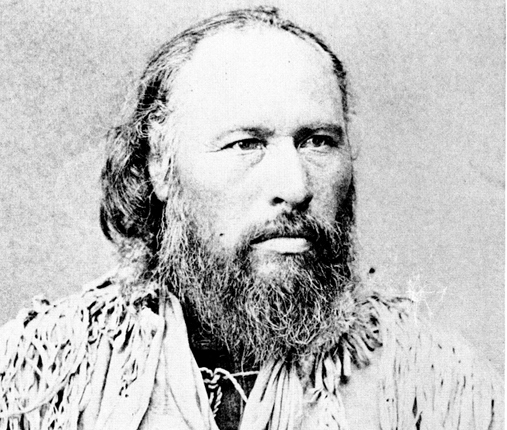
Gabriel Dumont
“We see public figures not as men, but as functions.”
-
-
- George Woodcock, 1975.
-
The 1885 North-West Rebellion marked an important epoch in the history of Canadian confederacy and Canada’s expansion westward. Many notable figures have, as a result, become the forefront of public interest and intellectual curiosity, including the likes of John A. Macdonald and Louis Riel. Yet, in this era defined much by Indigenous resistance and rebellion, one of the most prominent Métis leaders and folk heroes has been overlooked, hidden in the shadows of Macdonald and Riel. Despite having been neglected in the historical literature, the story of Gabriel Dumont has nonetheless become a symbol of heroism and survival for Métis communities across Canada.
Born in December 1837 to Isidore Dumont and Louise Laframboise, Gabriel Dumont was the eldest son of eleven children and the grandson of French-Canadian voyageur, Jean-Baptiste Dumont. Although he was born in present-day Winnipeg, Gabriel did not stay long as his family desired a more rural lifestyle, closer to their Métis family. In the summer of 1840, the Dumont family left Manitoba and began their journey toward Fort Pitt, Saskatchewan.
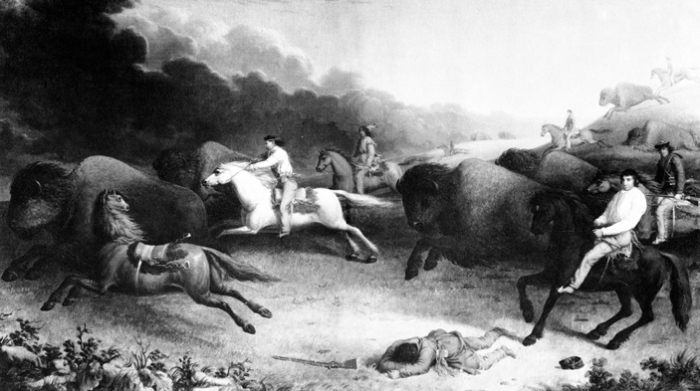
While on route to their new home, Gabriel, roughly 3 years old, accompanied his father in the great buffalo hunt of 1840, an event he would later lead as hunt chief in 1863. At the 1840 grand event, Gabriel met famous buffalo chief and his future father-in-law, Jean-Baptiste Wilkie. But, more importantly, it was the first time Gabriel witnessed and learned the ways of Métis buffalo hunting – skills which would later help him become the elected leader of the Saskatchewan buffalo hunt as well as a legendary guerrilla general.
From a young age, Gabriel learned how to live off the land and survive in the wild by having engaged in a regular routine of hunting and trading. It was uncommon for Métis children to receive a traditional, European style of education, and Gabriel was no exception. Despite being illiterate, Gabriel obtained knowledge others lacked, including his ability to speak seven languages and memorise the prairie landscape. Additionally, by the age of 10, he was able to accurately shoot and handle both a rifle and a bow.
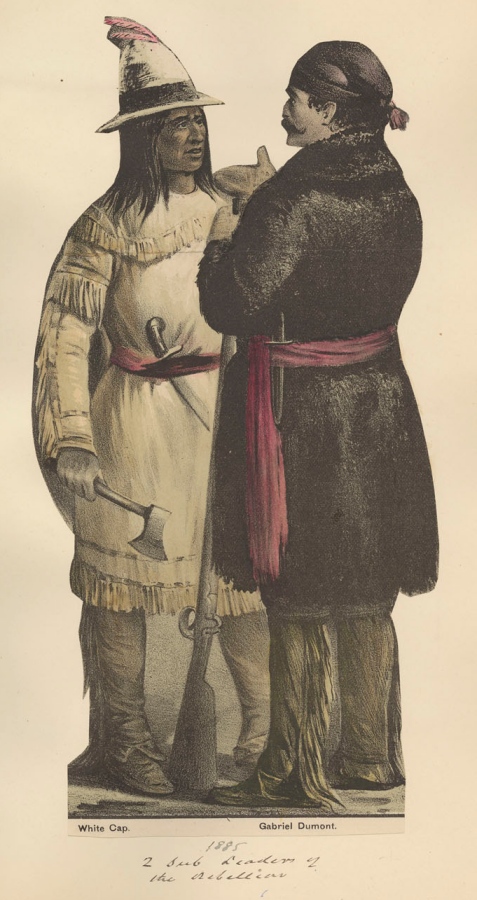
His adeptness proved critical as Gabriel was exposed to the harsh realities of the plains and the dangers posed by both animals and people. Thus, having understood the landscape and the skills of a hunter became useful to ensure his survival. In July 1851, at just 13 years old, Gabriel fought at the Battle of Grand Coteau and killed a person for the first time. It would not be the last time he would take the life of a man threatening the Métis.
However, Gabriel also believed in peaceful resolutions and played a vital role in facilitating a treaty with the long-lasting enemy of the Métis, the Blackfoot. Due to his dedications as a hunter, role model, and leader within the Métis community, Gabriel was elected as hunt chief in 1863, leading their annual buffalo hunts. He maintained the role until 1881 during the period when the buffalo began to disappear. Gabriel understood the drastic change the disappearance of buffalo would pose to the Métis way of life; therefore, he sought to ensure their own identity would be maintained. In 1873, Gabriel would help form a new Métis government in St. Laurent de Grandin, Saskatchewan, and was voted as president.
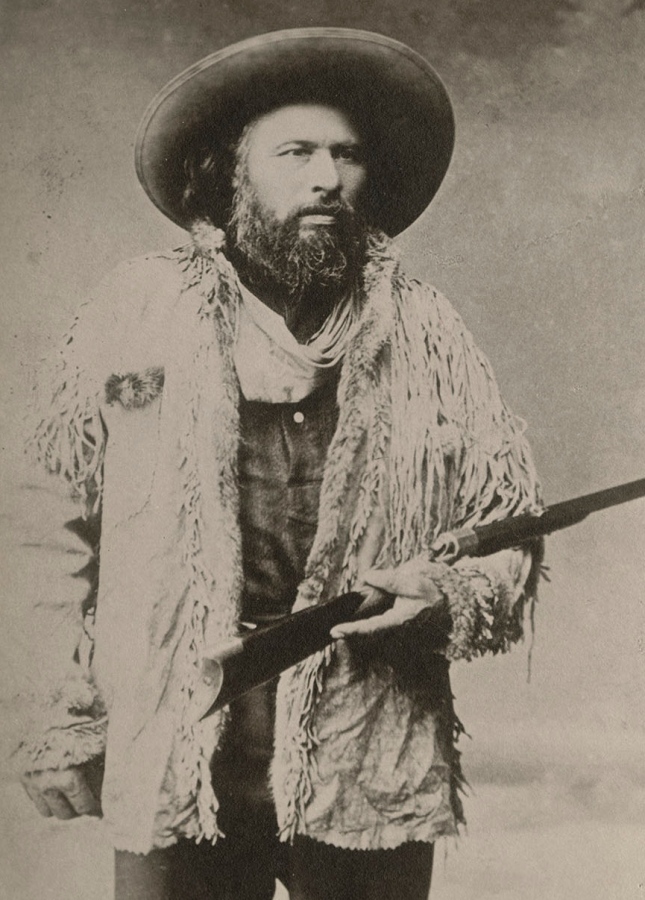
As tensions grew between John A. Macdonald’s government and the Métis in the early 1880s, Gabriel played a crucial role in both attempting negotiations and inciting an insurrection. In 1884 he travelled to Montana and recruited Louis Riel to the Métis cause, having hoped Riel would provide expert guidance in negotiations with the government similar to the 1870 Red River Resistance. In 1885, upon failed discussions, Gabriel and Riel formed the Provisional Government of Saskatchewan and began the North-West Rebellion. Riel was determined to be president, and Gabriel the adjutant-general – in charge of soldiers and responsible for military action. Unfortunately for Gabriel, many of his decisions would be overruled by Riel.
On 26 March 1885, near the community of Duck Lake, commenced the first battle of the conflict. The Battle of Duck Lake lasted approximately 30 minutes, in which Gabriel’s brother, Isidore, was killed. Gabriel himself was even shot in the head, although the bullet deflected off his skull, having left a brutal scar that would last the rest of his life. Despite his injury, Gabriel picked up his rifle, Le Petit, and continued to lead his men to fight before their enemy retreated.
Following the assault at Duck Lake, Gabriel began to plan strategic guerrilla assaults aimed to demotivate the Canadian soldiers. However, Riel preferred an amicable resolution to the conflict and Gabriel yielded to his president’s assessment.
Regrettably for the Métis, their lack of waging a war of attrition, combined with their depleting ammunition and resources, meant that they were fighting a losing battle. Nevertheless, with the guidance of Gabriel, the Métis were able to delay the Canadian soldiers from reaching Batoche. When the Battle of Batoche did eventually begin, Gabriel and his men defended their town for four days. When they ran out of ammunition, they began to use nails and other metals to fight. Ultimately, Batoche was captured, Riel surrendered, and Gabriel went into hiding, having made his way down to the United States.
It was while in hiding that the enigma surrounding Gabriel began to develop within the Métis community. Stories circulated so quickly that the guards patrolling Riel in Regina believed Gabriel was planning to raid the prison and rescue his friend – though that never occurred.
While exiled in the United States, Gabriel’s wife, Madeleine Wilkie, died of tuberculosis. Gabriel would spend the next twenty years living without her. After Madeleine’s death he briefly involved himself in Buffalo Bill’s Wild West Show until he became a public speaker. In 1886 the Canadian government granted an amnesty for Gabriel and allowed him to return to Batoche. There he began speaking of his life which his friends wrote into a memoir, on account of Gabriel’s illiteracy. On 19 May 1906, at 68 years old, Gabriel Dumont died of heart failure and was buried at Batoche, the town he famously defended.
Despite having been overshadowed by Louis Riel, Gabriel Dumont left behind a legacy as a man dedicated to his people. To this day, Métis communities revere and cherish Gabriel not for his function in history but for the man he was to their community and to their culture.
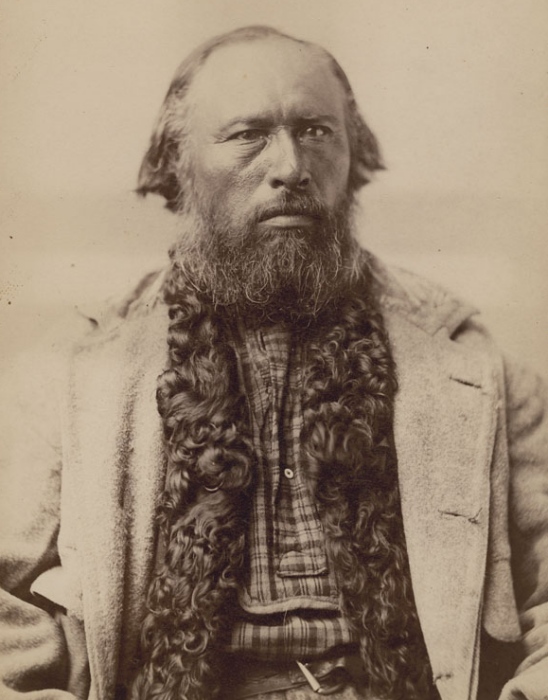
Main image: Gabriel Dumont. (Credit: Gabriel Dumont Institute of Native Studies and Applied Research)
Suggested Readings:
Gabriel Dumont: The Metis Chief and His Lost World by George Woodcock and J. R. Miller.
Louis Riel and Gabriel Dumont by Jospeh Boyden
Sources:
Boyden, Joseph. Louis Riel and Gabriel Dumont. Extraordinary Canadians, Penguin, 2013.
Daschuk, James W. Clearing the Plains: Disease, Politics of Starvation, and the Loss of Indigenous Life. New edition. University of Regina Press, 2019.
Dumont, Gabriel, and Michael Barnholden. Gabriel Dumont Speaks. Talonbooks, 1993.
Gaudry, Adam. “Gabriel Dumont.” The Canadian Encyclopedia, 2008/2019. https://thecanadianencyclopedia.ca/en/article/dumont-gabriel#RisetoPoliticalProminence
Morton, William. “The Battle at the Grand Coteau: July 13 and 14, 1851.” Manitoba Historical Society Archives, 2012. https://www.mhs.mb.ca/docs/transactions/3/grandcouteau.shtml
“The Buffalo Hunt.” Gabriel Dumont Institute of Native Studies and Applied Research, n.a. https://www.metismuseum.ca/media/document.php/03152.riverhunt.pdf
Woodcock, George, and J. R. Miller. Gabriel Dumont: The Metis Chief and His Lost World. University of Toronto Press, 2019.