

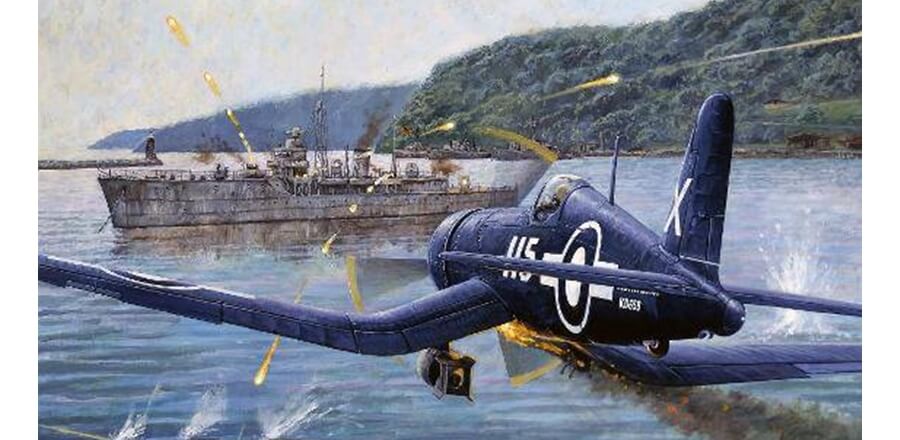
Another Aug. 9, 1945: Lt Gray
This is part 1 of a 4 part series generously provided by the Embassy of Japan in Canada. Minor edits by Valour Canada.
Part 1 – Part 2 – Part 3 – Part 4
August 9, 1945
At 11:02 a.m. on August 9, 1945, near the end of World War II, a plutonium atomic bomb was dropped on Nagasaki. In an instant, the lives of an estimated 70,000 people were taken away. August 9th is remembered by people all over the world. It is a exceptional day to commemorate the victims, pray for peace, and reaffirm our commitment to a world without nuclear weapons, with Nagasaki the last city to suffer by an atomic bomb.
Meanwhile, August 9, 1945 was also the day of the Onagawa Air Raid. Eighty years have passed since then, and though it is rarely mentioned and seems to have fallen into long-forgotten memory, it was part of an operation aimed at clearing out any remaining Allied ships off the coast of the Tohoku region. Onagawa Bay, located on the Oshika Peninsula in Miyagi Prefecture, is a natural harbor on a ria coast, and towards the end of the Pacific War, the Imperial Japanese Navy’s transport fleet was secretly deployed here. The escort ship Amakusa, the target ship Ohama, the No. 42 submarine chaser, and several other minesweepers, special ships, small tankers, etc. were anchored there. The Allies discovered this through reconnaissance and intelligence, and launched an air raid using aircraft from the British aircraft carrier HMS Formidable. Seven of these ships, which were anchored in Onagawa Bay, were sunk or severely damaged and stranded. Furthermore, the Japanese side suffered casualties of over 200 people, including 158 defense force personnel and ship crew members, and local residents. One of the survivors was Private First Class Yoshio Kanda (22 years old), a communications soldier in the Onagawa Defense Force. In contrast, the Allied forces suffered only one casualty. That was Lieutenant Robert Hampton Gray of the Royal Canadian Naval Volunteer Reserve.
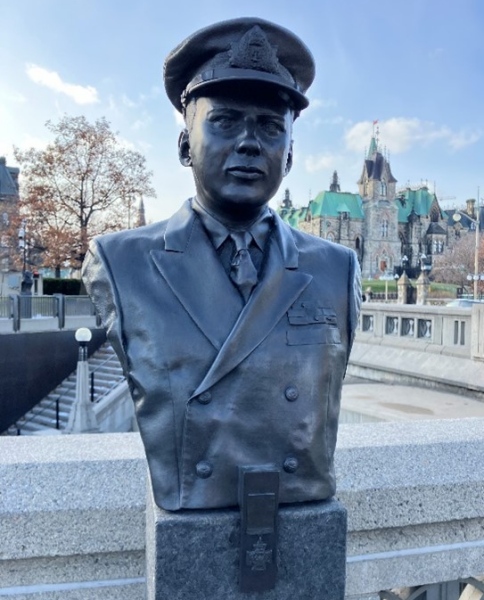
Lt Gray’s bust at the Valiants Memorial, Ottawa. (Courtesy of the Embassy of Japan in Canada)
Lieutenant Robert Hampton Gray
Lieutenant Gray was born in November 1917 in Trail, a remote town in the Canadian Rockies in British Columbia (BC) on the west coast of Canada. Both of his parents were immigrants from the UK, and his father worked in the local Trail mines. As he grew older, he went on to study at the prestigious University of British Columbia. His friends affectionately called him “Hammy.” In the summer of 1940, he completed his general courses and became a pre-med student.
The international situation at the time was at a major turning point due to the Second World War. Although the war broke out with Nazi Germany’s invasion of Poland on September 1, 1939, the main battlefields initially were Eastern and Northern Europe, and it was also called the “Phony War.” However, on May 10, 1940, Germany suddenly invaded Belgium and France. Germany then quickly occupied both countries and began air raids on London, decisively changing the course of the war.
In such circumstances, young Gray volunteered for the reserves out of patriotism for Canada, loyalty to the Commonwealth, and affection for his parents’ homeland, Britain. Fascinated by fighter planes, he aspired to become a pilot, and after training in the UK, he was recruited as a pilot for the Vought F4U Corsair carrier-based fighter. Although the Corsair was a heavy and difficult fighter to handle, Gray distinguished himself in the African and Norwegian campaigns and was promoted to lieutenant. He became regarded as a respected pilot.
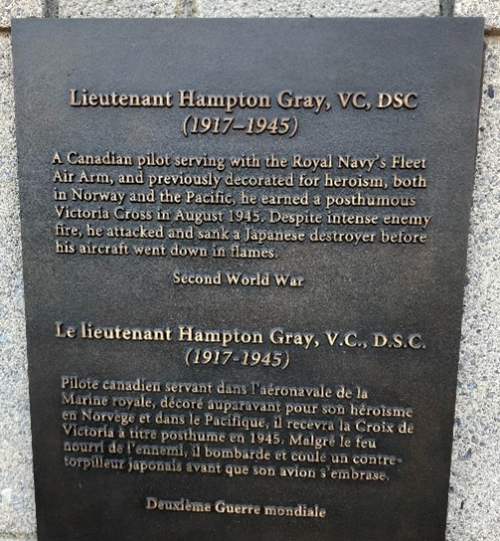
Lt Gray’s plaque at the Valiants Memorial, Ottawa. (Courtesy of the Embassy of Japan in Canada)
In April 1945, Lieutenant Gray was transferred to the Royal Navy’s Pacific Fleet and assigned to the aircraft carrier HMS Formidable. After the Battle of Okinawa, the task force centered around the aircraft carrier deployed to the Tohoku coast in August. Then the fateful day of August 9th arrived. Lieutenant “Hammy” Gray took off just after 8:00 a.m. as the attack leader, spearheading a squadron of Corsair fighter planes. He flew low and dropped a bomb on the escort ship Amakusa but was hit by concentrated Japanese artillery fire and crashed, killing him. He was 27 years old.
Lieutenant Gray was the last Canadian soldier killed in action during World War II. He was awarded the Victoria Cross, Canada’s highest honour, and remains the only recipient in the history of the Royal Canadian Navy. Looking back at Canada’s history, war has played a major role in its development from a French and British colony to a dominion and then a sovereign nation. In a corner of Confederation Square in the heart of the capital, Ottawa, stands the Valiants Memorial, which features busts of 14 war heroes from the French and Indian War to World War II. Lieutenant Gray is one of them. He is a Canadian hero.
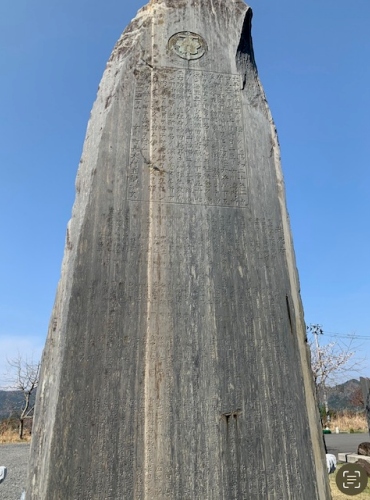
Memorial Tower for the Victims of the Onagawa Air Raid. (Courtesy of the Embassy of Japan in Canada)
Valour Canada’s article about Lt. Gray and his actions can be viewed here.
Main photo: Don Connolly’s “Finale”, a depiction of Lt. Gray’s final approach on the Japanese Amakusa (Credit: Canadian War Museum, 19880046-001).