

The First Anti-Ship Guided Missiles (1943)
Researched and written by William (Bill) Dziadyk, author of “S.S. Nerissa, the Final Crossing”. Minor edits by Valour Canada.
The seas of Europe became a proving ground for a new chapter in naval warfare. For centuries, ships had fought ship-to-ship, using conventional weapons such as cannons, gunnery, torpedoes, and the skill of their crews.
In 1943, Germany had unveiled a new weapon unlike the Allies had faced before, a radio-controlled guided bomb, capable of striking with deadly precision. This innovation crippled warships once thought to be invincible, forever changing the nature of naval combat. The following describes these new weapons and the respective situations in which they were first used.
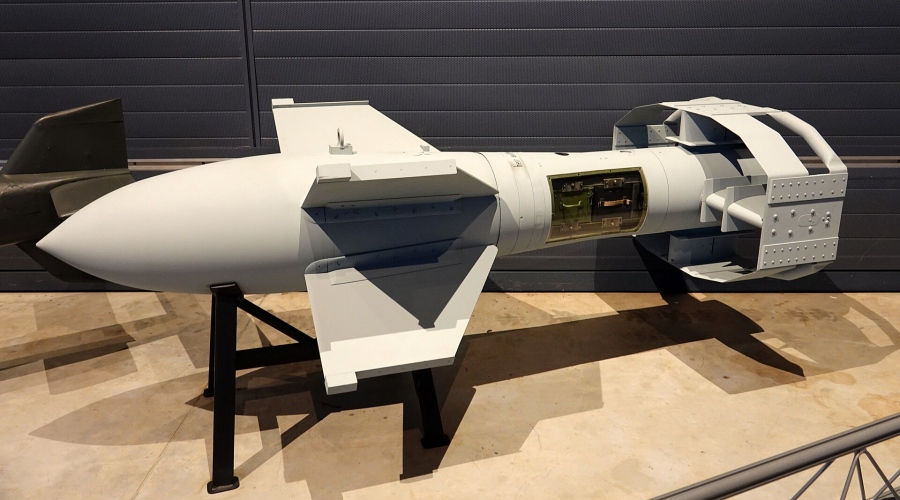
The Ruhrstahl SD 1400 (aka Fritz-X) bombs were Germany’s first bombs to incorporate radio controlled guidance. These 3,450-pound armor-piercing bombs were designed to explode into and through the thick upper decks of capital ships. The bombs had four stabilizing side fins. A rocket thruster and two tail rudders were fitted in a box-shaped tail unit for controlling speed and downward course corrections. An aircrew bombardier with a joy stick had radio-control over the bomb’s downward gravity-based descent into its moving target.
Based on the earlier Fritz-X technology, the Henschel Hs 293 (glide bombs) were developed. These later missiles resembled a small rocket powered aircraft (fuselage length 12.5 feet with diameter 1.5 feet, and a wing span of 10 feet). Mounted under the bomb’s fuselage was the cylindrical main rocket motor. When launched, a small liquid-fueled rocket fired to speed up the weapon and get it out in front and to one side of the aircraft. The main propulsion rocket motor would then start for the descent and glide towards the moving target. The course, speed, elevation and targeting of these anti-ship missiles were radio-controlled by an aircrew bombardier using a joy stick.
The two anti-ship missile systems were both operational by mid-1943.
Henschel Hs 293 – Bay of Biscay – Aug. 1943
Seven months after her commissioning, the destroyer HMCS Athabaskan (G07) was anti-submarine patrolling in the Bay of Biscay off the coast of Spain, with Royal Navy ships which included: the 281 foot sloop HMS Bideford (L43), the former US Coast Guard cutter HMS Languard (Y56), and the 276 foot sloop HMS Egret (L75). On 25 August 1943, a squadron of Luftwaffe Dornier dive bombers appeared on the horizon. Each dive bomber was fitted with Germany’s newest anti-ship weapon: Henschel Hs 293 “glide bombs” which were mounted for release under each wing.
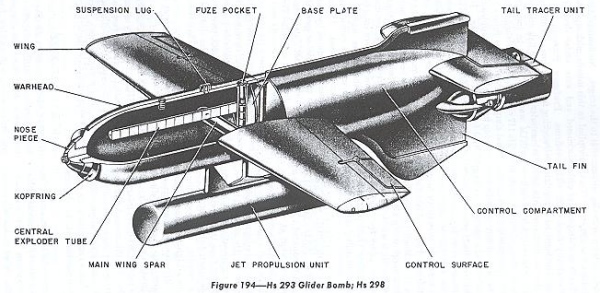
A schematic drawing of a Hs 293. (Credit: US Airforce – TM 9-1985-2/Air Force Technical Order TO 39B-1A-9)
HMS Bideford and HMS Languard are believed to be the first allied warships to have been struck by Henschel Hs 293 “glide bomb” missiles. The sloop Bideford was slightly damaged by a missile which did not detonate, however one crew member was killed. The cutter Landguard, survived a near miss with only minor damage. Two days later, on 27 August, the Luftwaffe attacked again and sank the sloop Egret.
Later that day, Athabaskan came under attack by a Dornier bomber and a Henschel Hs 293 glide bomb which slammed into her port side, between the “B” gun-deck and the wheel-house. The missile passed under the plot room, through Radio One, the Chief Petty Officer’s Mess and out the starboard side where it exploded. Bomb fragments pierced the starboard side and bridge.
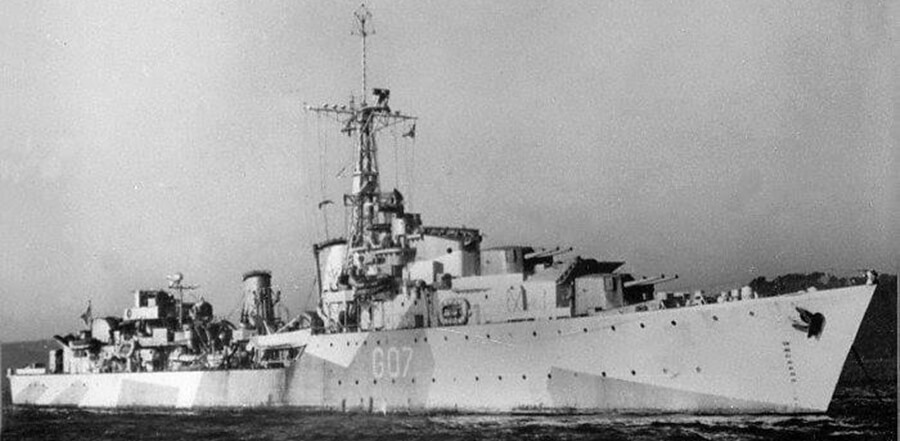
HMCS Athabaskan. (Credit: Imperial War Museum)
The Captain (Commander George R. “Gus” Miles) was knocked down by the blast and several officers had severe leg injuries. In Radio One, Telegraphist Charles Kent (a survivor from the sinking of the troopship S.S. Nerissa) lost both legs. Able Seaman Joseph McGrath, a bridge lookout, was killed. The crew of “B” gun received the worst of the injuries with Able Seaman William Pickett and Petty Officer Ernest Latimer being killed. Several members of the “A” gun crew were also burned or wounded. Leading Cook Frank Prudhomme of the gun crew was killed.
Thirty-five survivors from HMS Egret were embarked in HMCS Athabaskan, when she headed north at 14 knots for the Devonport dockyard, where she remained under repair until 10 November 1943.
Ruhrstahl SD 1400 (Fritz-X) – Mediterranean – Sep. 1943
Germany’s first major operational use of Fritz-X bombs occurred in the Mediterranean immediately after Italy’s 8 Sep 1943 capitulation. The Italian fleet had departed La Spezia and were on route to Malta to surrender the fleet. To prevent the Italian fleet from falling into Allied hands, six Luftwaffe bombers (each armed with a Fitz-X bomb) intercepted the Italian ships. On 9 Sep, the battleship Roma, the flagship of the Italian fleet, received two direct hits and sank when her magazines exploded. 1,255 crew, including Admiral Carlo Bergamini, were killed. The battleship Italia, was damaged, but reached Malta.
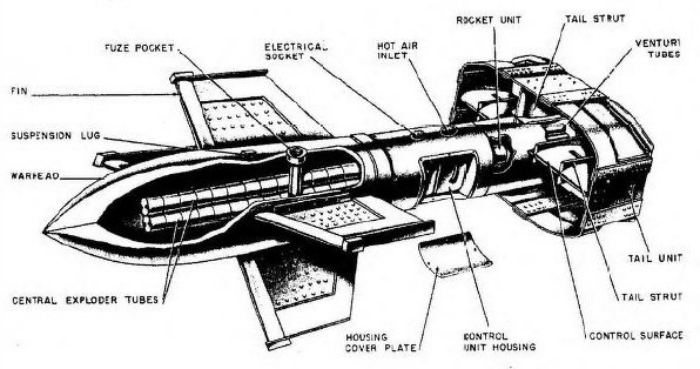
Fritz X/Ruhrstahl SD 1400 schematic. (Credit: Wikipedia)
Also in September, and in the Mediterranean, Luftwaffe bombers deployed Fritz-X bombs successfully against the:
- Light cruiser USS Philadelphia (8 Sep 1943, minor damage),
- Light cruiser USS Savannah (11 Sep 1943, major damage, 8 months to repair),
- Light cruiser HMS Uganda (13 Sep 1943, major damage, 13 months to repair). After repairs, she was commissioned into the RCN as HMCS Uganda and later as HMCS Quebec, and
- Battleship HMS Warspite (16 Sep 1943, major damage, 1 year to repair).
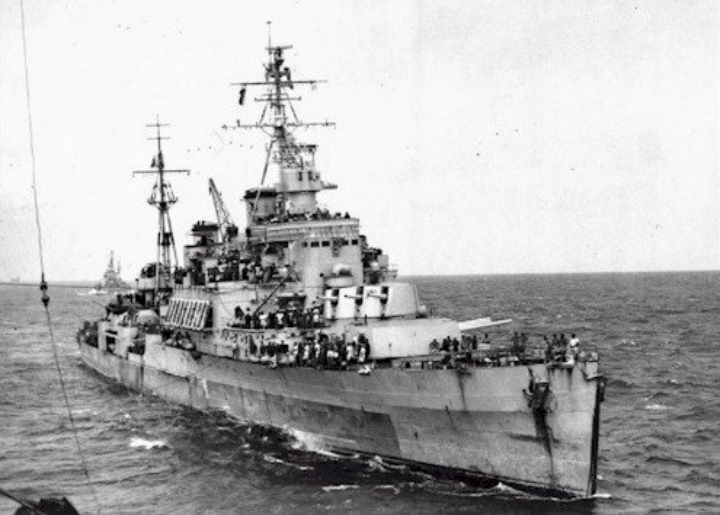
HMCS QUEBEC, formerly HMS UGANDA. (Credit: For Prosperity’s Sake)
Henschel Hs 293 – Convoy KMF-26 – November 1943
In 1943, United States Army units were being deployed to the China-Burma-India Theater via the Mediterranean. After American troopships arrived in Oran, Algeria, the US Army units would board British troopships which would join a convoy bound for India via the Suez Canal. On 15 November 1943, convoy KMF-26 had departed Clyde (Glasgow, Scotland) and was bound for India via the Mediterranean. Later on 25 Nov, after passing Oran, the convoy was joined by:
- Two troopships: His Majesty’s Transport (HMT) Rohna and HMT Egra;
- The hospital ship HMHS Karoa, and
- Four USN escorts: the destroyers USS Herbert C. Jones and USS Frederick C. Davis; and minesweepers USS Pioneer and USS Portent.
The HMT Rohna crew of 219 officers and men included the Master (Thomas J. Murphy, an Australian) and 16 naval and 2 army DEMS gunners. The passengers included 1,981 American troops with seven Red Cross personnel… and three British Army medical officers with ten army medical orderlies.
In mid-afternoon of the following day (26 Nov), eight allied fighter aircraft, sighted and engaged Luftwaffe bombers which had been approaching the convoy. Some bombers made it through the fighter screen and dropped bombs from about 10,000 feet, which were not effective. However, the German force included fourteen Heinkel He-177 dive bombers, each armed with two Henschel Hs-293 glide bombs. When the traditional vertical gravity bombing proved ineffective, the dive bombers began launching their radio guided Henschel Hs 293 glide bombs at ships in convoy KMF-26.
The Luftwaffe dive bombers first target was the C-class light cruiser HMS Colombo, which avoided being hit by five Hs 293 glide bombs. The jamming of radio control frequencies by USS Herbert C. Jones had significantly helped.
However, a single Hs-293 missile slammed into the port side of HMT Rohna, just above the water line and into the engine room. The resulting explosion blew out the starboard side hull plates below the water line. The troop transport sank killing 1,015 American Soldiers and 134 (British and Australian merchant navy, Indian crew and other passengers).
The entire attack on convoy KMF-26 lasted about half an hour, followed by USS Pioneer rescuing 606 Rohna survivors. An after action USN report stated “In all, about 25 Hs-293 glider bombs were dropped. The Portent claimed the destruction of two planes. The total number of enemy planes encountered was estimated at 25, of which 15 were probably He-177s.”
Details, of the sinking of HMT Rohna and the American casualties, were highly classified during the war … and for many years afterwards.
Main photo: The Fritz X also known as the Ruhrstahl SD 1400 or Ruhrstahl X. (Credit: Sanjay Acharya via Wikipedia)