
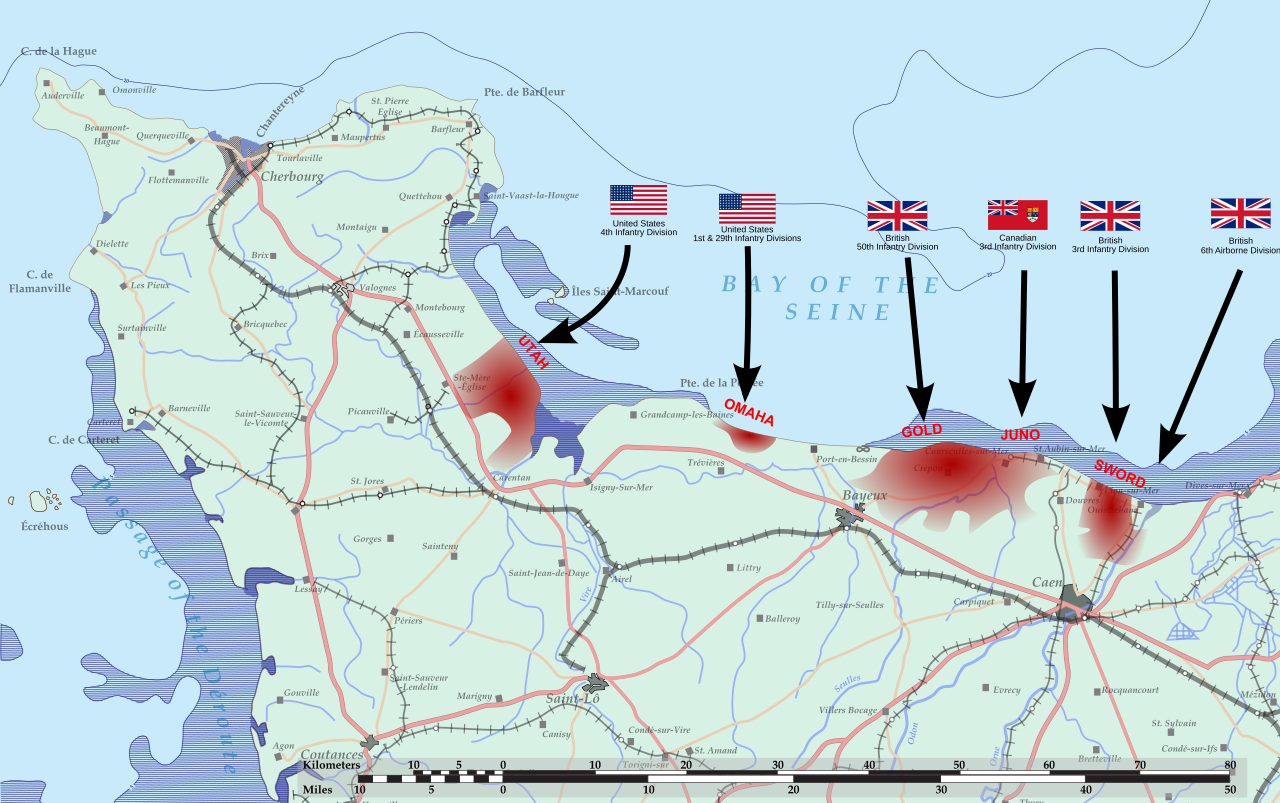
The British and Canadian Beaches
Written by James Robertshaw. This article is a consolidation of 4 books: British 6th Airborne, British & Canadian Beaches, United States Beaches, and French Resistance & The Special Operations Executive (SOE). The books are available at James’ site and via Lulu. Minor edits by Valour Canada.
The following is a consolidated excerpt that describes the British and Canadian Beaches – Sword, Juno and Gold. The books cover major actions up until D-Day +8, the first Victoria Cross (VC) on D-Day awarded to Company Sergeant-Major (CSM) Stanley Hollis at Ver-sur-Mer, Major General Percy Hobart’s details of the 7th Armoured Division (Hobart’s Funnies), Eastern Task Force (naval and air power details), deception plans, Bletchley Park, and the SOE (details are in a separate publication called ‘The French Resistance and the SOE’).
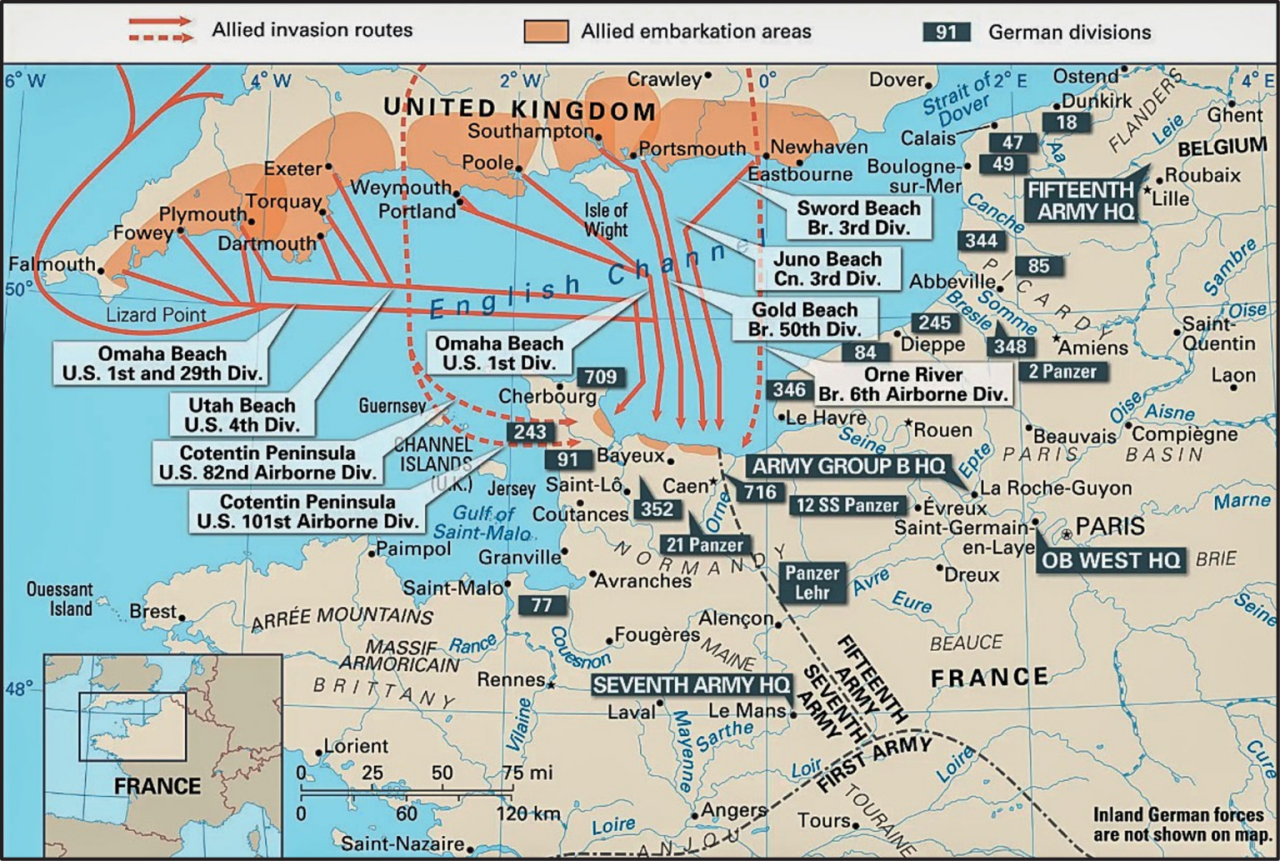
British 6th Airborne
The 6th Airborne was formed in 1943 from other units in the British Army, especially from units who served in North Africa, e.g., Cornwall Light Infantry. Men joined as they were offered more money and training back in good old blighty (a nickname for England/Great Britain). None of the men had jumped out of an aircraft before, but a lot were trained for glider landings. Several new gliders had been developed. The main glider was the Horsa glider, but larger gliders called Hamilcars were developed to carry Jeeps and tanks. The parachute jumps were carried out by using Albemarle and C47 Dakotas. Training was intense. Special training occurred outside Newbury where a reconstruction of the Merville Battery was built for Lt Colonel Otway, 9th Parachute Infantry Brigade. The operation, called Mallard, depended on good weather, but the division took off in bad weather (remember there was no satellite navigation). The units were guided in by various beacons from the Pathfinders (22nd Independent Parachute Brigade) who were the first to take off. A Canadian Parachute battalion (1st Parachute Battalion – Lt Colonel Bradbrooke) jumped on the 6th June as part of the 3rd Parachute Brigade, which took off from Harwell and Brize Norton. Their task? To blow up the bridges at Varaville and Robehomme.
The gliders did a remarkable job, in particular the 2nd Battalion Ox and Bucks landed within 50 yards of their objective Pegasus Bridge, however many units were blown off course and didn’t land anywhere near their targets. (e.g. one glider, Ox and Bucks, landed by the River Dives, while D Company of the 9th, landed on the other side of the River Dives and were captured).
The Objective of the Division commanded by Major General “Windy” Gale was to hold the Eastern Flank of the beaches from German Counter attack until relieved. They were to blow all the bridges over the River Dives (the Germans had flooded that area), except Pegasus Bridge; it crosses the River Orne/Orne Canal.
The Germans had planted stakes in the ground to stop glider landings and had batteries (e.g., Merville Battery) overlooking Sword Beach. Those batteries needed to be taken, otherwise the Sword Beach Landings would not succeed. The 6th Airborne Division had minimal to zero tank support; they had only 20 very lightweight Tetra Recon Tanks, some of which were knocked out quickly by German anti-tank weapons. In the books you will see a write-up by Captain Vere who guided the guns on HMS Ramillies and Warspite to support the Airborne.
There was a big battle at Le Mesnil to stop a German Counterattack and many actions. The drop zones had to be defended by land reinforcements. Eventually the 6th British Airborne had support from Sword Beach, 1st Special Service Brigade.
Casualties were high – this is recorded in the book by unit, together with the citations and medals won. Many of our soldiers are buried in the cemetery at Ranville. One man in particular, Lieutenant Chicken, commander of D platoon, 2nd Battalion, Ox and Bucks is buried there – he died on the 6th of June and was in charge of the Mortar Platoon at Pegasus Bridge.
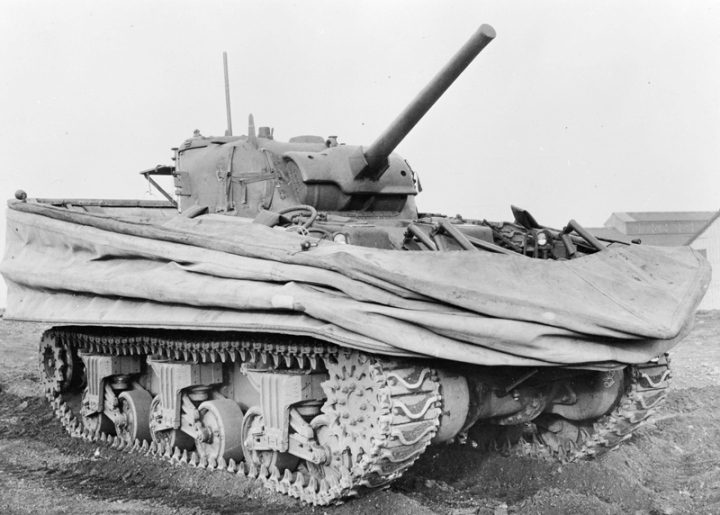
Sword Beach
SWORD was the code name for the British landing beach for the 3rd Division. Prior to D-Day the Allies had tried a dummy landing at Dieppe in August 1942 using primarily Canadian Units – they were not prepared and lost the battle with a casualty rate of 75%.
Once D-Day arrived, the Allies, and in particular, the British, were well prepared for the fortifications and well trained. The British had gathered intelligence (e.g., Operation Hardtack 21) on what the Germans had in place owing to the use of Bletchley Park code breaking as well as from the courageous French Resistance and its agents, e.g., Violette Szabo. The British had practised landings at Studland Bay. They dropped window (i.e., aluminum foil chaff) to confuse the Germans’ radar. The 79th Armoured Brigade had been formed under Major General Hobart who designed a range of tanks to overcome the obstacles on the beaches. They were ready. The weather was still against them and there were rough seas, but this did not deter them.
The 3rd Division landed on Sword with support from the 13-18th Hussars in DD Tanks. Many units were Royal Marine Commandos – their objectives are in the book. Some of the units were ordered inland from Sword to take the German Batteries and defences of Hillman and Morris. Many medals were won at Sword. The objective to take Caen was halted when the Germans released the 21st Panzer Division which halted the advance, but the main task, to secure the beach on the first day, was complete. One fortification in Ouistreham, the Grand Bunker WN08, was so strong that it was surrounded for 3 weeks until it surrendered. The 1st French Commandos under Capitaine Kieffer, with No.4 Commando, stormed the also formidable Riva Bella fortification. Code names had been given to all the German fortifications with WN reference numbers (Wilderstandnesten – “nests of resistance”) – all these fortifications are mapped and photographed in the books.
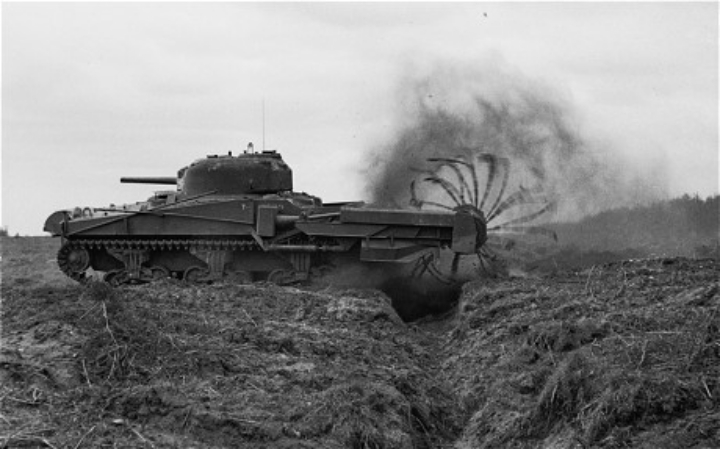
Juno Beach
JUNO was the code name for the Canadian beach landings – the 3rd Canadian Division (commanded by Major General Roderick Keller) would assault the beach, supported by the 2nd Canadian Armoured Brigade, and reinforced by the 1st Polish Armoured Brigade. The objective of the Canadians was to take Carpiquet airfield. They had three objective lines, Yew, Elm and Oak, each of which was achieved on D-Day. The book includes a write up on the counterattack by the 12SS Panzer Group and the executions of Canadian soldiers.
Many of the Canadian troops had never been out of Canada and this was a big adventure for them. Many fought bravely and were awarded medals; many are buried in the Canadian cemetery at Reviers . . . but there is also a small cemetery at Secqueville-en-Bessin and another at the Château d’Audrieu where executions took place.
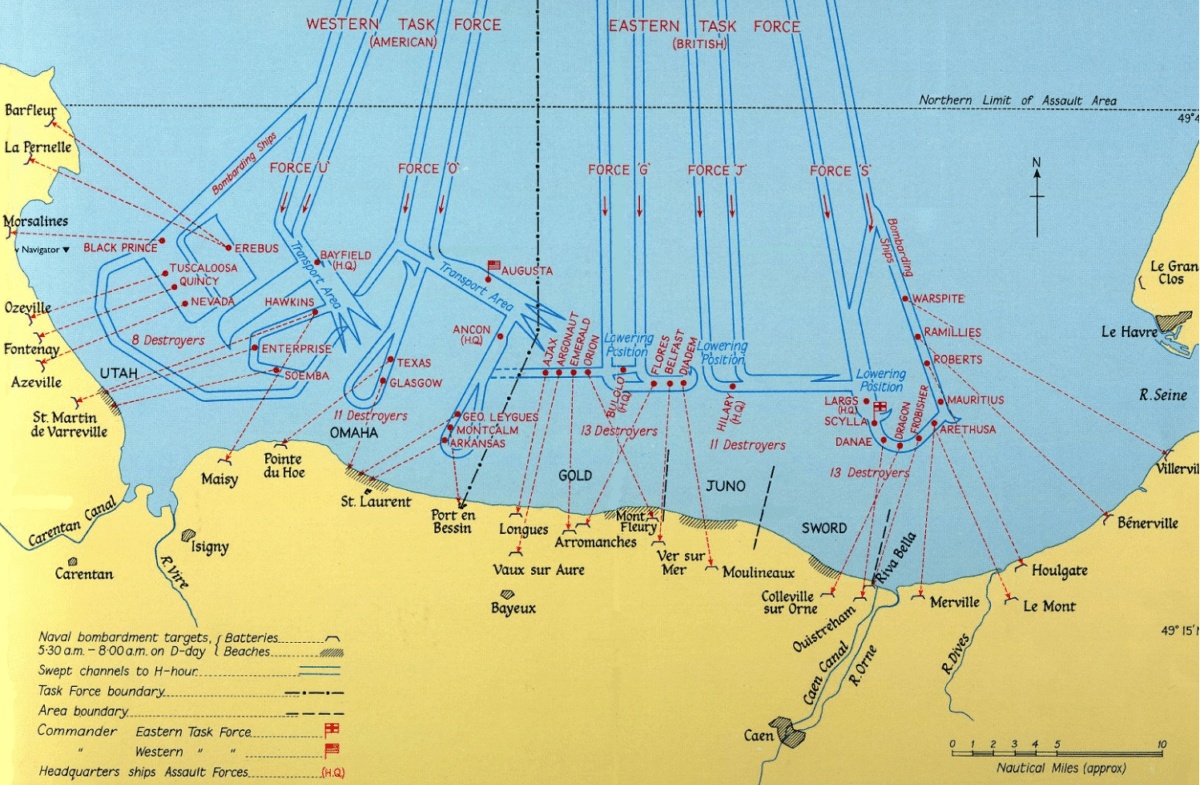
Gold Beach
The British 50th (Northumbrian) Infantry Division landed on Gold beach supported by the 8th Armoured Brigade and three squadrons of Royal Engineers’ tanks (Hobart’s Funnies) to clear obstacles. The first VC was won on this beach by Company Sergeant Major Stanley Hollis of the Green Howards and this action is documented.
The Allies had spent a lot of time on Operation Hillside (Hughenden Manor) mapping the beaches and fortifications in place – this helped the landings on all the beaches, especially Gold. One of the objectives of those at Gold was to secure Arromanches and also Port-en-Bessin to allow the construction of the British Mulberry Harbour (Mulberry B – code named Winston). At Arromanches they were also tasked with laying the fuel supply line PLUTO (Pipe Line Under The Ocean). This would allow the allies to be resupplied until Cherbourg or another port had been secured and activated. The Americans also had a Mulberry Harbour at Saint Laurent (Mulberry A), but this was destroyed in a storm in July. Both are discussed in detail in the Gold Beach book.