

Another Aug. 9, 1945: Arctic Strategy in the 21st Century
This is part 4 of a 4 part series generously provided by the Embassy of Japan in Canada. Minor edits by Valour Canada.
Part 1 – Part 2 – Part 3 – Part 4
After completing the necessary preparations, HMCS Gray will be deployed to Canadian Naval Base Esquimalt on the Pacific coast, where it will take on the role of protecting the Arctic Ocean from the Pacific Ocean and the Bering Strait.
Here, I would like to take a bird’s-eye view of the situation surrounding the Arctic. The Arctic was once a harsh polar region surrounded by thick ice and a paradise for adventurers, but it is now a 21st-century frontier where the national interests of various countries clash and harsh geopolitical realities are mercilessly manifested. During the Cold War, the Arctic was a frontline in the conflict between the United States and the Soviet Union, but after the Cold War, it became a good model of international cooperation and collaboration, as seen in the establishment of the Arctic Council (AC) in 1996. However, Russia’s “annexation” of Crimea in March 2014 and its invasion of Ukraine in February 2022 caused the AC to become dysfunctional. The Arctic has once again become a contested space.
Meanwhile, experts say the Arctic Ocean is warming four times faster than the rest of the world. Some have pointed out that the Arctic Ocean will be “almost ice-free” by summers of the 2030s. If the Northwest Passage becomes navigable year-round, it will bring about a revolutionary change in global shipping. This is why the Arctic Ocean is said to be the Suez of the 21st century. At the same time, the Arctic is a treasure trove of natural resources. The United States Geological Survey estimates that 13% of the world’s unproven oil reserves and 30% of its natural gas reserves remain in the Arctic Ocean. Furthermore, it is rich in mineral resources such as nickel, copper, uranium, rare earths, and diamonds. In short, the value of the Arctic is increasing in terms of shipping routes, resources, and access.
The situation surrounding the Arctic is changing dramatically in both security and economic terms. For Canada, which has 25% of its territory in the Arctic, the Arctic is a key security and potential business opportunity. Meanwhile, Russian air force aircraft have been frequently violating Japanese airspace, and Russian and Chinese activities in the Arctic Ocean have also become more active, raising concerns. The latest national defence strategy, released in 2024, is titled “Our North, Strong and Free.” It’s simple and to the point.
Based on this national defence strategy, the Royal Canadian Navy will deploy six state-of-the-art Arctic patrol ships, including HMCS Gray, to the Arctic. Five of the six ships are based at the Naval Base Halifax on Canada’s east coast, protecting the Arctic from the Atlantic side. HMCS Gray will handle the Pacific side.
Taking advantage of the opportunity of the naming ceremony, I exchanged views with Minister of National Defence McGuinty, Royal Canadian Navy Commander Topshee and Royal Canadian Air Force Commander Speiser-Blanchet, who were also in attendance. We evaluated recent developments in Japan-Canada relations, including growing cooperation in the security field, and agreed on the importance of the deployment of HMCS Gray and the Arctic region.
Also extremely memorable was my interview with Commander Brian Henwood of HMCS Gray. The commander is a large, strong man who gives the impression of being a seasoned naval soldier. He expressed his pride in being appointed commander of a ship named after a Canadian naval hero, saying, “In my previous job, I was captain of a ship tasked with monitoring the Arctic Ocean. I also had experience tracking suspicious Chinese ships. I feel that the geopolitics surrounding the Arctic Ocean is becoming more severe by the day. HMCS Gray is a larger and more powerful ship than my previous mission ship. I am determined to accomplish my mission.” He also expressed his desire to make an early port call at Onagawa, where Lieutenant Gray died, and to cooperate with Japan. If HMCS Gray’s port call in Onagawa becomes a reality and concrete cooperation progresses, it will be an event symbolizing the evolution of Japan-Canada relations.
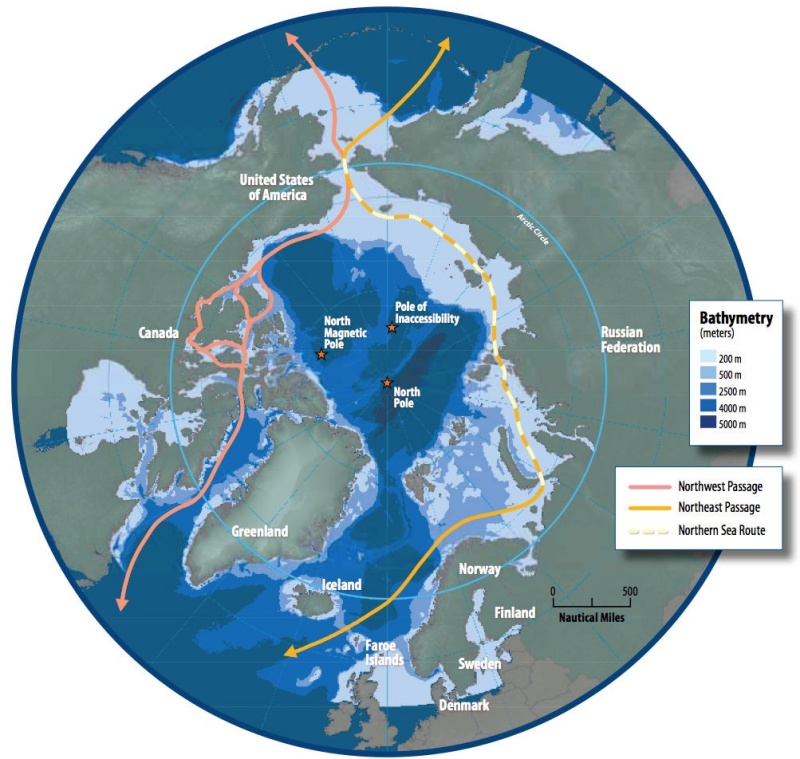
Arctic sea routes. (Credit: Arctic Marine Shipping Assessment 2009 Report via https://www.pame.is/images/03_Projects/AMSA/AMSA_2009_report/AMSA_2009_Report_2nd_print.pdf)
Yesterday’s enemies become today’s friends and tomorrow’s allies for peace.
The current situation in the Arctic is severe. President Trump’s remarks regarding Greenland and Vice President Vance’s visit there can also be seen as demonstrating the necessity and inevitability of Arctic strategies. Frankly speaking, the deployment of HMCS Gray alone will not change the situation, but it is only a small first step. Still, it’s a timely and appropriate move. It is expected that it will be further reinforced in the future.
In this regard, Canada’s icebreaker construction capabilities are attracting attention. In July 2024, Canada, the United States, and Finland signed the Icebreaker Collaboration Effort Pact. The objectives of this agreement are: to ensure security and freedom of navigation in the Arctic Ocean; to promote search and rescue, scientific research and surveillance activities in the polar region; and to promote the sharing of icebreaking technology and personnel training – but its core focus is industrial cooperation in the construction and maintenance of icebreakers. In addition to Irving Shipbuilding, which built the HMCS Gray, Canada is also home to Davie Shipbuilding, one of the world’s leading shipbuilding companies, founded in 1825. Canada and the United States are moving forward with cooperation on Arctic strategy, despite tariff issues.
Japan is also closely monitoring the situation in the Arctic not only from the perspectives of the global environment, business, indigenous peoples, and international cooperation, but also from the perspective of security. The “Action Plan for contributing to a free and open Indo-Pacific region” agreed upon between the foreign ministers of Japan and Canada also explicitly calls for cooperation in the Arctic. The Japan Self-Defense Forces are also participating as observers in Operation NANOOK, a joint exercise in the Arctic organized by the Canadian military and involving the U.S. military. Economic and business ties with resource-rich Canada have long been close, but Japan-Canada cooperation in the field of security has also progressed, and the Arctic, a frontier for the 21st century, has come into view.
Lieutenant Robert Hampton Gray, who was killed in action at Onagawa on August 9th 80 years ago, symbolizes the new Japan-Canada relationship of the 21st century, in which “yesterday’s enemy become today’s friend and tomorrow’s comrade for peace.”
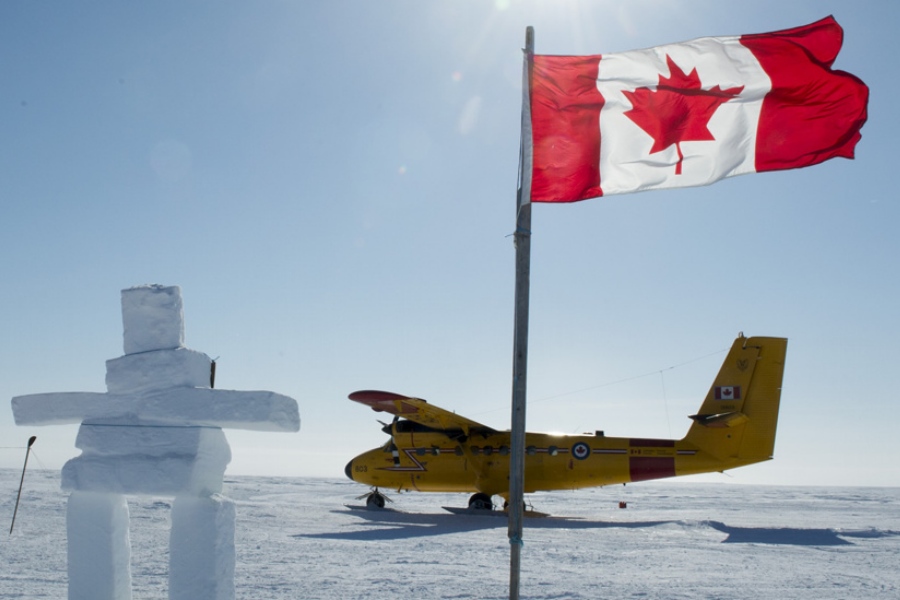
Main photo: Canada in the Arctic. (Credit: Canadian Armed Forces Image Gallery via https://www.cgai.ca/rights_of_passage_its_time_the_us_recognizes_canadas_arctic_claim)