

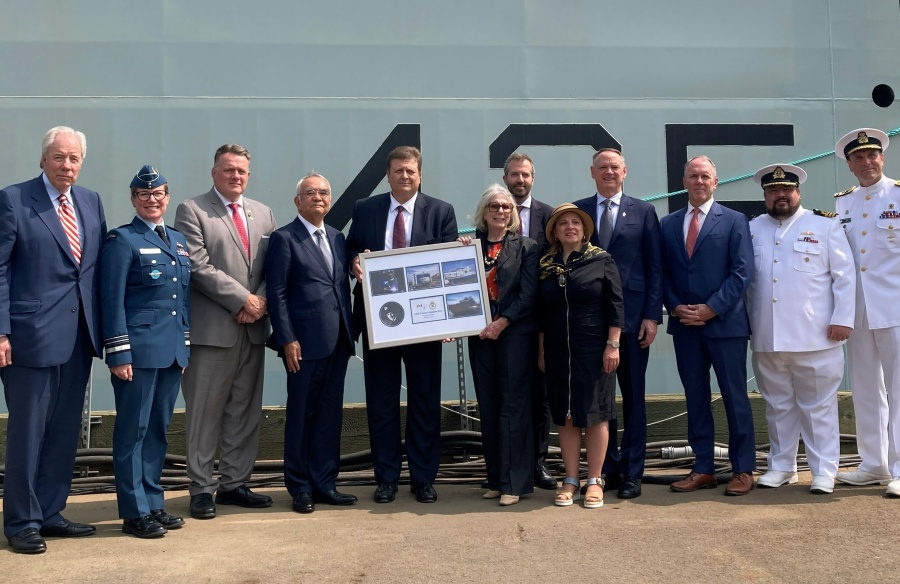
Another Aug. 9, 1945: Naming Ceremony
This is part 3 of a 4 part series generously provided by the Embassy of Japan in Canada. Minor edits by Valour Canada.
Part 1 – Part 2 – Part 3 – Part 4
In July of this year, I received an invitation. It said that a naming ceremony for the Royal Canadian Navy’s newest Arctic and offshore patrol ship will be held at Naval Base Halifax on August 9th, and that the ship will be named HMCS Robert Hampton Gray. The naming ceremony was planned to mark the 80th anniversary of Lieutenant Gray’s death (9 August 1945). Due to the importance to Canada-Japan relations, I was also invited as the Japanese Ambassador to Canada.
However, as someone from Nagasaki Prefecture, I was torn. August 9th has been special for as long as I can remember. I vividly remember visiting Nagasaki Peace Park and the Nagasaki National Peace Memorial Hall as part of a social studies class in the third grade of elementary school. Among the mementos were a bent wall clock that stopped at 11:02, photographs of Nagasaki immediately after the atomic bomb was dropped, photographs of victims covered in keloid scars, and Dr. Nagai’s dedication. I was so scared that night that I couldn’t fall asleep.
A memorial ceremony for the victims of the atomic bomb was also planned for August 9th in the Ottawa-Gatineau metropolitan area. It was the 80th anniversary and I was invited. I wished I had two bodies, but after careful consideration, I traveled to Halifax to attend the naming ceremony. What I saw there was extremely memorable.
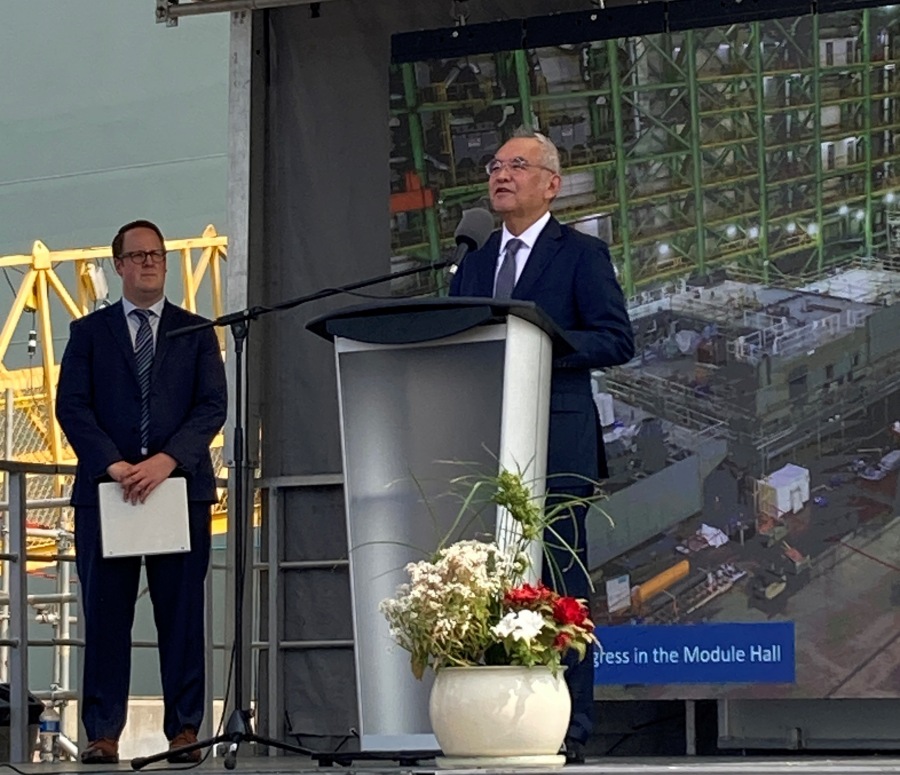
Ambassador’s Speech at the Naming Ceremony. (Courtesy of the Embassy of Japan in Canada)
First, there was HMCS Gray. The patrol ship moored at the quay was completely different from what it looked like in photos, and I was overwhelmed by its huge, gallant appearance. It is 103 meters long, displaces approximately 6,600 tons, has a maximum speed of 17 knots, and has a range of 6,800 nautical miles.
Its main missions are maintaining sovereignty in Arctic waters, patrolling territorial waters, responding to disasters, and supporting NATO and international missions. To cope with the harsh environment, it has icebreaking capabilities that allow it to continuously break through two-meter-thick first-year ice at three knots. Equipped with an insulated structure and powerful heating and ventilation systems, it can operate autonomously in the Arctic for 120 days without resupply. Additionally, it has a large flight deck and hangar and can carry CH-148 Cyclone anti-submarine patrol helicopters.
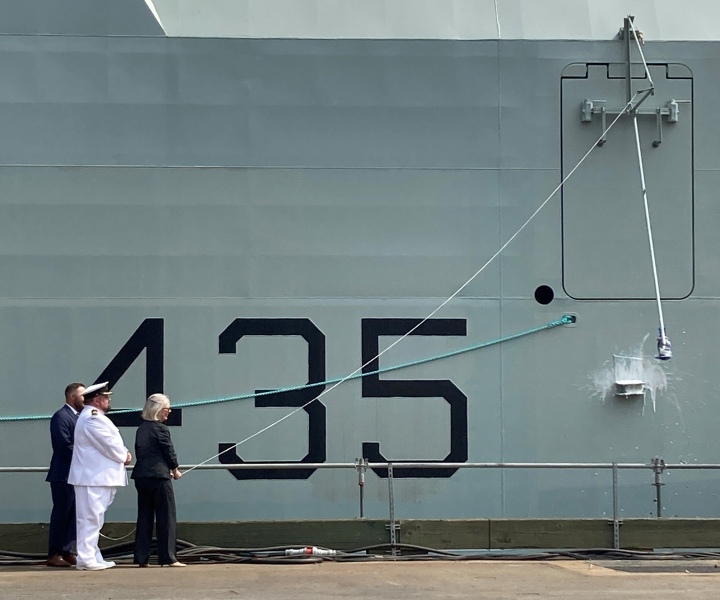
Shipping Christening at the Naming Ceremony. (Courtesy of the Embassy of Japan in Canada)
The naming ceremony was attended by many guests, who gave speeches one after the other. First came Lieutenant Governor Mike Savage, followed by the Japanese Ambassador to Canada, which means I was given a higher-ranking position than the Minister of National Defence and the Minister of Government Transformation, Public Works and Procurement. The order of greetings was significant. This clearly demonstrates not only the significance of Lieutenant Gray in terms of Canada’s defence policy, but also the importance and priority that the Canadian government places on Japan-Canada relations. I pointed out that as Japan and Canada continue to cooperate toward the realization of a “Free and Open Indo-Pacific,” we can expect progress in cooperation in the Arctic in the future. I also explained that, amidst the dramatic development of Japan-Canada relations, the inscription of Lieutenant Gray’s name on the ship was supported by the beliefs of Mr. Kanda Yoshio, and that Mr. Kanda’s grandson Yoshitake and great-grandson Ibuki had also been invited to the naming ceremony that day. At that moment, the audience erupted in cheers for both of them. After the naming ceremony, a crowd gathered around the Kanda family and Lieutenant Gray’s relatives. It was a sight that made me realize that the foundation of relations between countries is the friendship between individuals.
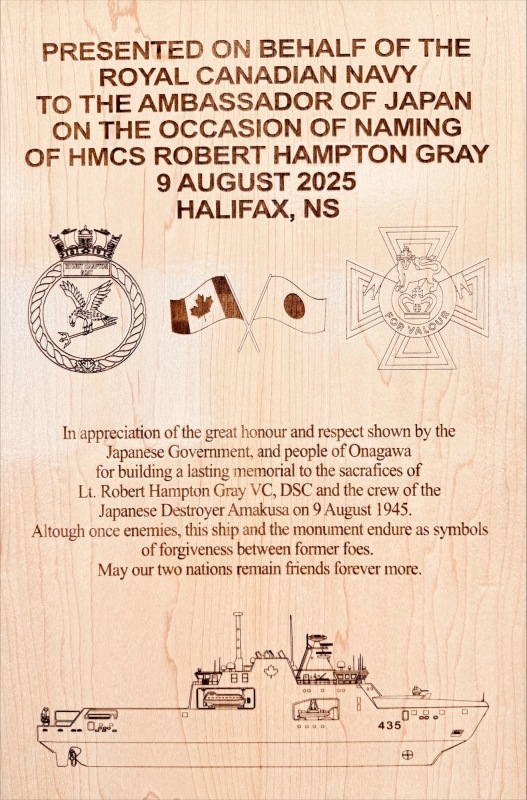
Commemorative Plaque for the Naming Ceremony. (Courtesy of the Embassy of Japan in Canada)
Main photo: Group photo at the Naming Ceremony. (Courtesy of the Embassy of Japan in Canada)