

Another Aug. 9, 1945: Kanda Yoshio
This is part 2 of a 4 part series generously provided by the Embassy of Japan in Canada. Minor edits by Valour Canada.
Part 1 – Part 2 – Part 3 – Part 4
Next, let’s turn our attention to Onagawa. Private First Class Kanda, who survived the Onagawa Air Raid, was born in 1922 and is from Saitama Prefecture. After the war, he remained in Onagawa and ran a local clothing store. His business developed smoothly amid the rapid economic growth that followed the war. He was also actively involved in the activities of the Kaiyu Shinwakai, a veterans’ association made up of local former military personnel. In 1966, 21 years after the end of the war, he used his own money to erect a memorial tower to commemorate the victims of the Onagawa Air Raid.
Fast forward to 1989. Japan was in the midst of its bubble economy. Although economic friction between Japan and the United States was extremely severe, Japan-Canada relations were not plagued by any serious problems and both were developing steadily as G7 members. The Canadian government came up with a plan to erect a memorial for the hero Lieutenant Gray at the site of his downfall in Onagawa. In January, the Embassy of Canada in Tokyo presented the plan to the town of Onagawa. However, local opposition arose. Even 44 years after the end of the war, the scars of the Onagawa Air Raid remained deep. Lieutenant Gray may have been a hero on the Canadian side, but to local families, he was an “enemy” who led an air raid that took the lives of more than 200 people. The local opposition left construction of the memorial on the verge of remaining a dream.
At that moment, Mr. Kanda Yoshio spoke up. “Japanese and Canadians share the same hatred for war. What we hate is not enemy soldiers, but war itself,” he said. Mr. Kanda Yoshio, who had been a member of the Defense Force and survived the devastation of the air raids, and who used his own money to build a memorial for the local victims, understood the feelings of the victims’ families better than anyone. He sincerely met with people who opposed the idea and talked about accepting a memorial for Lieutenant Gray.
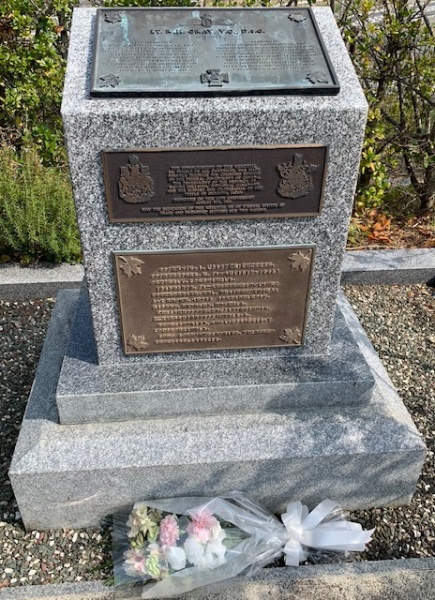
Captain Gray Memorial in Onagawa. (Courtesy of the Embassy of Japan in Canada)
The Gray Memorial, Japan-Canada Friendship, and the “Miracle Flag”
The memorial was completed in August 1989. It is a symbol of mourning and respect for Lieutenant Gray, and a testament to the friendship between Japan and Canada that has transcended hostility. Lieutenant Gray’s sister, Phyllis, and other relatives also attended the unveiling ceremony. The people of Onagawa welcomed them warmly. It’s a wonderful bond between Japan and Canada. Incidentally, this is said to be the only memorial monument in Japan that has the personal names of foreign soldiers engraved on it.
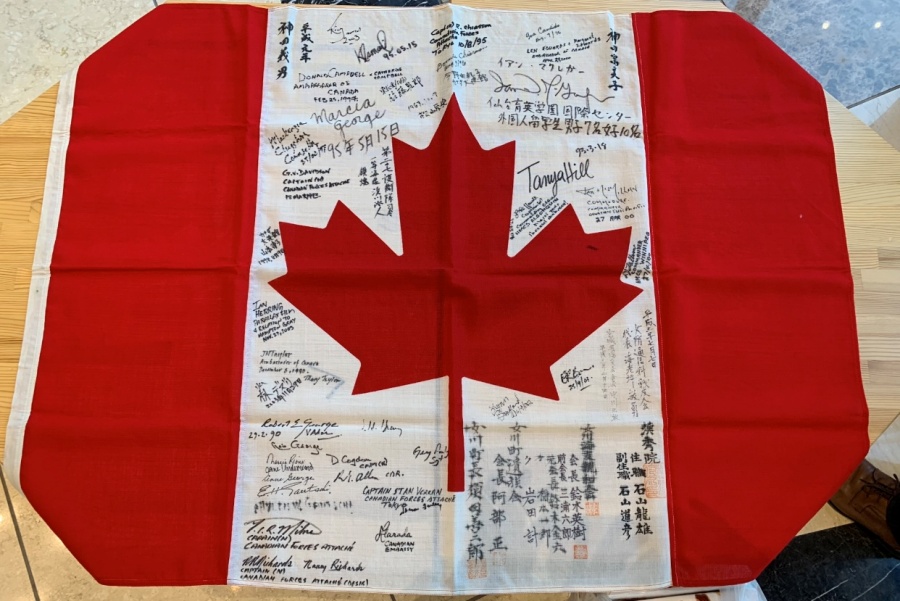
For the unveiling ceremony, Mr. Kanda had prepared a Canadian flag for messages to be written on. Participants from both Japan and Canada wrote messages and their names. Since then, Mr. Kanda has brought the flag with him on various occasions as a symbol of friendship between Japan and Canada, and the number of messages written by people connected to Japan and Canada has increased.
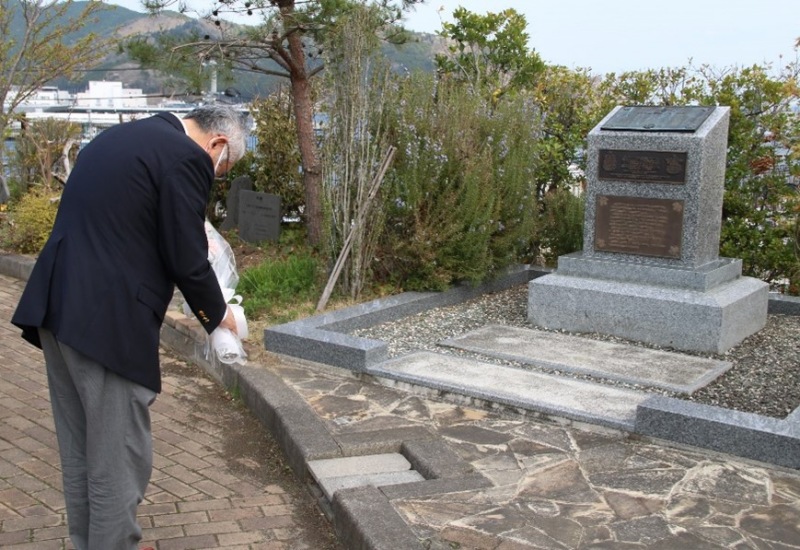
Ambassador Yamanouchi laying flowers at the cenotaph. (Courtesy of the Embassy of Japan in Canada)
The connections made by Onagawa gradually expanded. In the midst of this, Marcia George, the granddaughter of Lieutenant Gray’s sister Phyllis, attended University of British Columbia, just like her great-uncle Lieutenant Gray, and earned a master’s degree in international relations in 2000. She then participated in the JET Programme, spending two years in Miyagi Prefecture as an assistant English teacher. During that time, she visited Onagawa, where her great-uncle died and where the memorial monument stands. There, she met with Mr. Kanda Yoshio and other members of the Kanda family, and the two families began to interact. However, Onagawa and Vancouver are very far apart geographically. Nevertheless, they continued to exchange letters. To put it quite simply, it is a private exchange between two families who came together by pure chance under unusual circumstances. Still, the relationship is genuine. In 2003, Marcia’s wedding was held in Vancouver, and the Kanda family was invited. The relationship between Lieutenant Gray’s family and the Kanda family deepened.
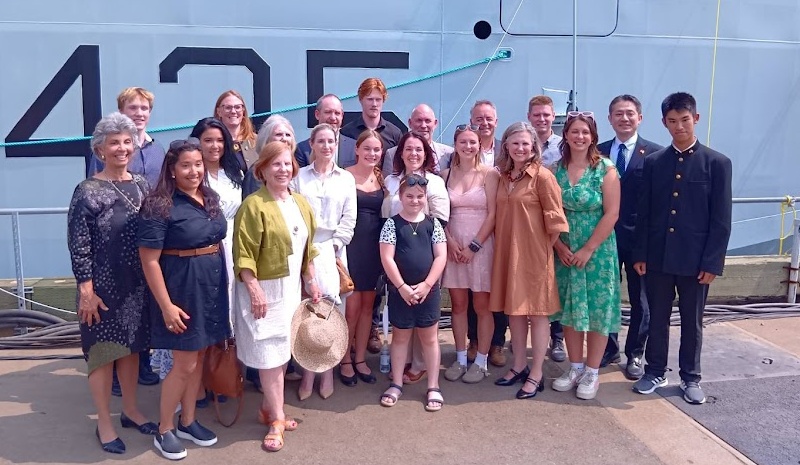
Kanda Family and Lieutenant Gray’s Relatives. (Courtesy of the Embassy of Japan in Canada)
Mr. Kanda Yoshio passed away in 2005 at the age of 83. The two men, of the same generation, fought for their respective countries as enemies in Onagawa on August 9, 1945. Fate is cruel. Lieutenant Gray was killed in action, but Private First Class Kanda survived. Mr. Kanda devoted the latter half of his life to promoting friendship between Japan and Canada. Yoshio’s aspirations were passed down to his family, and messages continued to be written on the Canadian flag. Once the blank space was filled, messages continued to be written on a second Canadian flag.
Then, on March 11, 2011, the massive tsunami caused by the Great East Japan Earthquake struck Onagawa and engulfed everything. The Lieutenant Gray monument was also lost. However, it was rebuilt by the local people of Onagawa. Those who had previously opposed the construction of the monument, claiming it was a memorial to the “enemy,” in a sympathetic spirit, secured a spot on high ground overlooking the bay and erected a new monument, hoping to prevent further damage.
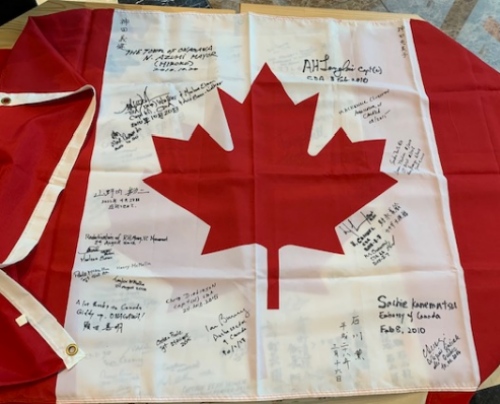
The Second Flag. (Courtesy of the Embassy of Japan in Canada)
The tsunami also showed no mercy to the Kanda family. The house was washed away and the entire family was killed, except for Mr. Kanda’s grandson Yoshitake, who lived in Sendai. Yoshitake returned to Onagawa every weekend to search, but days of disappointment continued with no leads. Then, in June, three months after the disaster, he found both the old and the new friendship flags carefully folded in plastic bags under the rubble. He said it was at a time when he had almost given up. It was the only thing left of the Kanda family, who had lost everything. It is truly a miracle.
And the collection of messages continues to this day. Both Canadian Ambassador to Japan Ian MacKay and I signed the flag, pledging to do our best to promote friendly relations between Japan and Canada. The story of Lieutenant Gray and Onagawa is already impactful enough, but there is more to the story.
Main photo: The First Flag. (Courtesy of the Embassy of Japan in Canada)