
CF-104 Starfighter
The Missile with a Man in it: Introduction
The CF-104 Starfighter is one of the Royal Canadian Air Force’s (RCAF) most iconic aircraft of the Cold War, celebrated for its record-breaking speed and altitude. Originally designed by Lockheed, an American aerospace company, the aircraft was later built under license by Canadair (now part of Bombardier). While initially developed as a high-speed, high-altitude interceptor, the CF-104 was modified to fulfill the RCAF’s operational requirements. With its sleek design and supersonic capabilities, the CF-104 was one of the fastest aircraft ever operated by the RCAF.
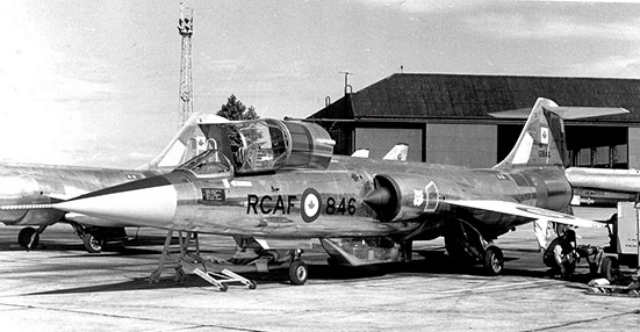
An RCAF CF-104 on the tarmac. (Credit: The Military Museums)
The Making of a Star:
The CF-104’s origin traces back to Burbank, California, where Lockheed engineer Kelly Johnson and his team developed the F-104 Starfighter in 1952. The CF-104 is the Canadian version of the American F-104, modified with unique features suited to RCAF operations.
Following the cancellation of the Avro Arrow, the RCAF sought to modernize its aging fleet of CF-86 Sabres. In July of 1959, the RCAF officially committed to acquiring 200 CF-104s. These were built under license by Canadair at their Cartierville facility located in Quebec, with the first CF-104 rolling out in March 1961. Along with the 200 CF-104s, an additional 38 Lockheed-built two-seater variants (CF-104D) were added to the fleet, stationed at CFB Cold Lake, AB, to be used as trainers.
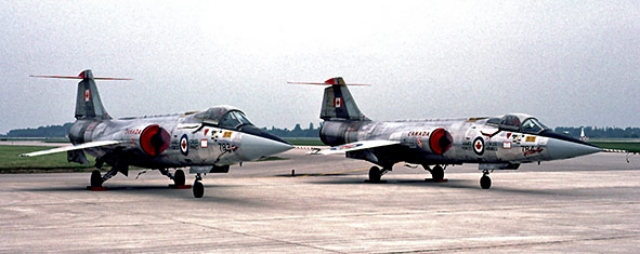
Two RCAF CF-104s on the tarmac at CFB Cold Lake. (Credit: The Military Museums)
While the F-104 was primarily designed to be a slender, high-altitude, high-speed interceptor, the RCAF specifically tailored the CF-104 for nuclear strike and photo-reconnaissance missions. To optimize the aircraft’s mission role, many additions and substitutions were made. Modifications included an R-24A NASARR air-to-ground radar set, a centerline-mounted reconnaissance pod with four Vinten cameras, longer-stroke liquid springs, and larger tires. The 20mm M61A1 cannon was removed to accommodate range-extending fuel tanks. Powering the CF-104s was the General Electric J79-19 turbojet engine built under license by Canadian manufacturer Orenda Engines, producing 11,810 lbs of thrust (17,900 lbs with afterburners).
On May 26th, 1961, the first CF-104 took to the skies, beginning 25 years of service with the RCAF. The first aircraft was delivered to 6 Strike/Reconnaissance Operational Training Unit (6ST/R OUT) at Cold Lake, AB. There were nine CF-104 squadrons, with eight of them deployed in Europe as part of Canada’s NATO commitment. The only squadron based in Canada was the 448 Squadron at CFB Cold Lake.
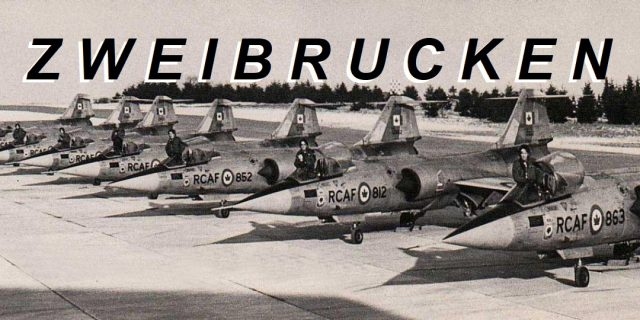
Squadron 427 Zweibrücken, West Germany. (Credit: International F-104 Society)
Specifications of the CF-104 Starfighter
Performance:
- Speed:
- 483 km/h at 40,000 ft
- 55 km/h at Sea Level
- Climb Rate:
- 30,000 ft in under 1.5 minutes
- Service Ceiling (Max Altitude Capability):
- 58,000 ft
Weight:
- Empty: 13,909 lbs
- Loaded: 21,005 lbs
- Max Take-Off Weight: 28,891 lbs
Dimensions:
- Wingspan: 21 ft and 11 inches
- Length: 54 feet and 9 inches
- Height: 13 feet and 6 inches
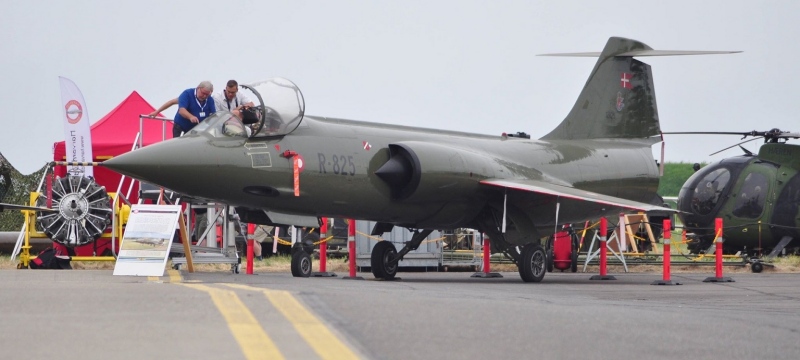
CF-104 (c/n 1125) R-825, Royal Danish Air Force, preserved Aalborg with 726Esk markings and tail from R-896. (Credit: Roger Seroo VIA International F-104 Society)
Canada’s NATO Commitment
The CF-104s stationed in Europe would form the RCAF’s Nuclear Strike Force operating from airbases in France and West Germany.
- 3 Wing RCAF Station Zweibrücken, Germany (December 1962)
- 427 Squadron (N-Strike)
- Later joined by 434 Squadron (N-Strike) (April 1963)
- 4 Wing RCAF Station Baden-Soellingen, Germany (July 1963)
- 422 Squadron (N Strike)
- 444 Squadron (N Strike)
- 2 Wing RCAF Station Grostenquin, France (Late 1963)
- 421 Squadron (N Strike)
- 430 Squadron (N Strike)
- 1 Wing RCAF Station Marville, France (March 1964)
- 439 Squadron (Photo-Recon)
- 441 Squadron (Photo-Recon)
After France began developing its own nuclear weapons program, it prohibited foreign powers from storing weapons on French soil. As a result, 2 Wing RCAF Station Grostenquin was disbanded. 421 Squadron was moved to 4 Wing Baden-Soellingen, and 430 Squadron was moved to 3 Wing Zweibrücken. As the Cold War waned, RCAF squadrons in Europe were gradually disbanded, with the final unit, 441 Squadron, standing down on March 1st, 1986.
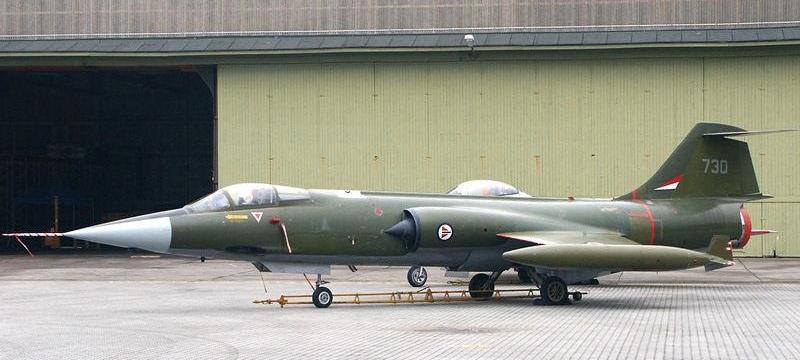
CF-104 (c/n 1030) 104730 “730”, Royal Norwegian Air Force, preserved with 334skv markings at Sola inside Fly Historisk Museum, Sola-Stavanger. (Credit: Anders Presterud VIA International F-104 Society)
Phase-Out:
During the 1970s, the RCAF shifted from its nuclear strike/reconnaissance roles to conventional warfare. The CF-104 was reconfigured as a multirole fighter, with the M61 20mm cannon reinstalled and an upgraded capacity to carry a variety of bombs. It also received upgrades to its radar systems, electronic self-defence equipment, and a new camouflage paint scheme.
In its original role, CF-104 pilots were usually deployed individually, flying fast and low to evade threats. Conventional operations required coordinated formation flying for protection and effectiveness.
The CF-104 developed an infamous reputation for its high accident rate, ultimately earning it the nickname “Widowmaker”. During its service life, 113 aircraft were lost, and 37 pilots were killed. While the small wings of the CF-104s allowed for great speed and climb rate, they also resulted in poor maneuverability and limited fuel capacity. Engine reliability issues and the aircraft’s demanding flight characteristics made it one of the most challenging jets to operate.
As newer technologies emerged, the CF-18 Hornet was chosen as its replacement. The CF-18 was a true multi-role fighter with advanced avionics, superior maneuverability, and greater operational range, reflecting the RCAF’s shift towards becoming a more modern and versatile air power. The phase-out of the CF-104s began in 1971 with aircraft being sold to NATO allies; the last CF-104s were retired by 1986.
- 22 CF-104s to the Royal Danish Air Force (RDAF)
- 22 CF-104s to the Royal Norwegian Air Force (RNAF)
- 50 CF-104s to the Turkish Air Force (TAF)
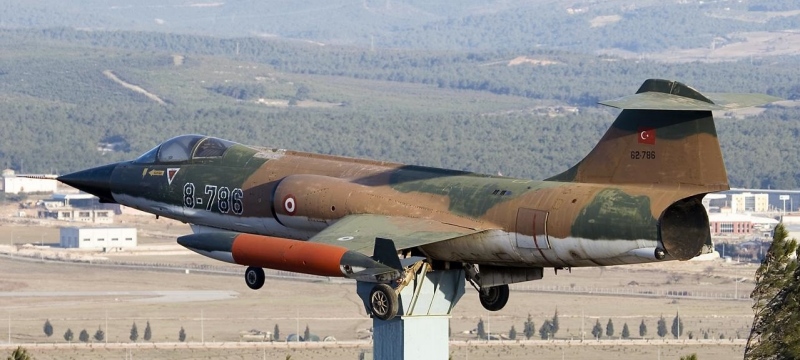
CF-104 (c/n 1086) 104786 “8-786” of 8 AJU, Turkish Air Force, preserved as “62-786” on a pole in the mountains at Sevgi Mh. South of Gaziemir/Izmir. (Credit: Turker Hasimoglu VIA International F-104 Society)
Conclusion
The CF-104 Starfighter marked a pivotal era in Canadian military aviation. As both a symbol of Cold War readiness and engineering ambition, it remains one of the most memorable aircraft to serve in the RCAF. Although retired, its legacy lives on in museums, memories, and Canada’s aviation history.
To learn more about the CF-104, see this video.
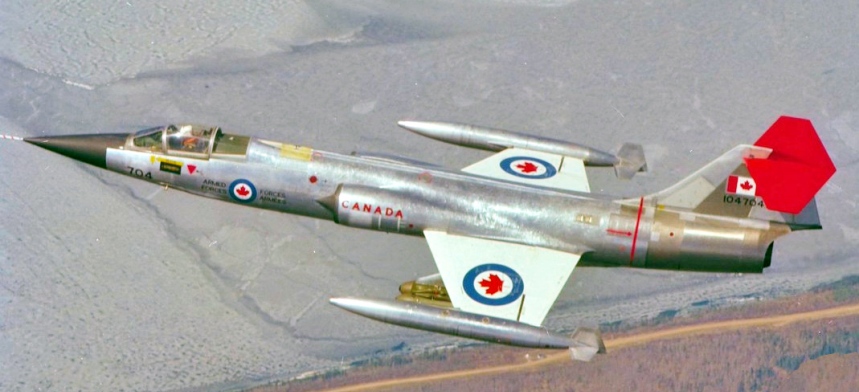
Main photo: An RCAF CF-104 in flight. (Credit: Wikipedia)