
The BCATP (British Commonwealth Air Training Plan)
On December 17, 1939, the British Commonwealth Air Training Plan (BCATP) was established by Canada, the United Kingdom, New Zealand, and Australia. The BCATP’s mandate was to produce an arsenal of well-trained aircrews. The United States and several Nazi-occupied countries in Europe also participated in training their men under the BCATP program. Across Canada, a network of airfields and schools were created, and over the course of its lifespan more than 130,000 personnel were trained, making it one of Canada’s most important contributions to the Allied victory.
Canada’s involvement in aviation training began during the First World War, when the Royal Flying Corps established operations in Canada and trained 10,500 pilots and mechanics. With the outbreak of the Second World War, Britain once again turned to Canada as a reliable training ground for aircrews. Canada’s geographical advantages included its vast open skies, ideal weather for flying, and proximity to the American manufacturing industry. Crucially, it was also close enough to Britain to allow for safer and faster transport of aircrew and equipment.
Across the country, air training schools were established (except in Newfoundland – it was not a part of Canada at the time). Approximately 104,000 Canadians staffed and managed these facilities. The BCATP was organized into four training commands, each with its own recruiting offices and supply services:
- 1 Training Command for Central Ontario (headquartered in Toronto, ON),
- 2 Training Command for Northern Ontario to Northern Saskatchewan (headquartered in Winnipeg, MB),
- 3 Training Command for Eastern Ontario, Quebec, and the Maritimes (headquartered in Montreal, QB),
- 4 Training Command for Southern Saskatchewan, Alberta, and British Columbia (headquartered in Calgary, AB)
No. 4 Training Command was particularly well-suited for training new pilots, thanks to its wide-open space, clear skies, and sparse population – this provided students with ample space to learn safely at minimal risk to the public. However, training remained inherently demanding and dangerous. Tragically, 856 trainees lost their lives during their training in the BCATP.
Click here to view an interactive map of the various BCATP schools across Canada.
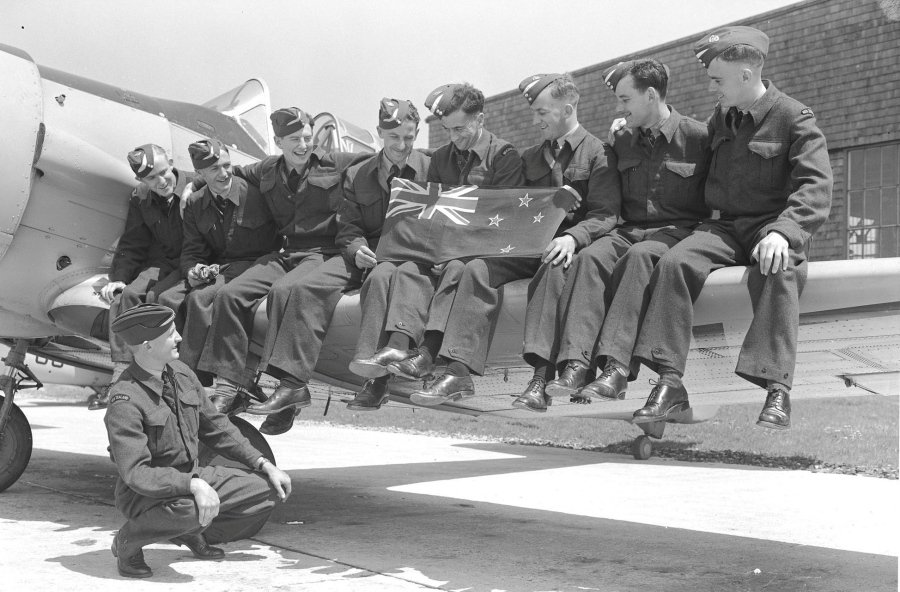
New Zealand airmen display their national pride with their country’s flag after graduating from the RCAF’s No.6 Service Flying Training School at Dunnville, Ontario, in May 1943. (Credit: DND Archives)
Trainees arrived from Allied countries around the world to take part in the program, settling into small airfield communities throughout Canada. Many local residents welcomed the BCATP and its trainees with open arms, seeing it as a source of new opportunities.
Women also played a key role. The Women’s Division (WD) of the Royal Canadian Air Force was established on July 2, 1941, with authorization from the Canadian federal cabinet. These women worked in a wide range of essential roles, including as wireless operators, dental assistants, pharmacists, analysts, and other technical and administrative trades. A total of 17,038 women served in the RCAF Women’s Division, with 30 losing their lives while on active duty.
At the height of its operations, the BCATP operated 107 schools and 184 supporting units spread across 231 sites nationwide. These facilities were staffed by 104,113 men and women and housed nearly 10,906 aircraft. Roughly 131,533 aircrews graduated from the program and went on to serve in various operational roles across multiple theatres of the Second World War.
Most of those who trained and graduated in the BCATP were Canadian, around 72,835 in total. These graduates served in the RCAF home defence squadron, overseas RCAF units, and RAF squadrons; they played a vital role in Allied air operations throughout the conflict. By late 1943, the BCATP had become so successful and efficient that it even maintained a reserve of trained aircrews waiting for assignment.
As the war drew to a close, BCATP schools across Canada began to wind down and shut their doors. Many communities that had grown around these training centres felt mixed emotions. There was sadness at seeing the trainees depart, but also a sense of relief and gratitude that the war ended. The program’s scale, speed, and organization left a lasting legacy, not only in its contribution to Allied victory but in the deep ties it forged between Canadians and the global war effort.
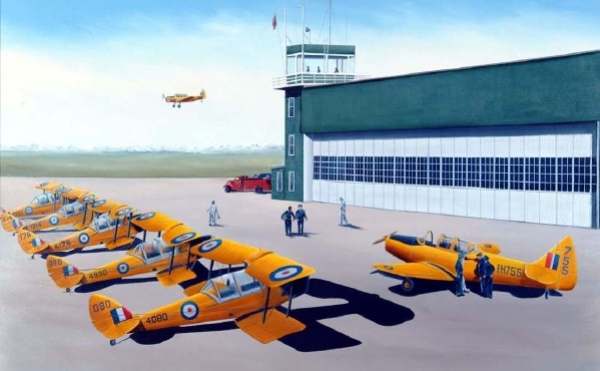
“The First Cornells” is a commissioned painting by John Rutherford for the Bomber Command Museum’s “Salute to the BCATP” event on August 24, 2002. This painting depicts the No. 5 Elementary Flying Training Station in High River, Alberta and the arrival of two new Fairchild Cornell Trainer aircrafts. (Credit: John Rutherford via Bomber Command Museum)
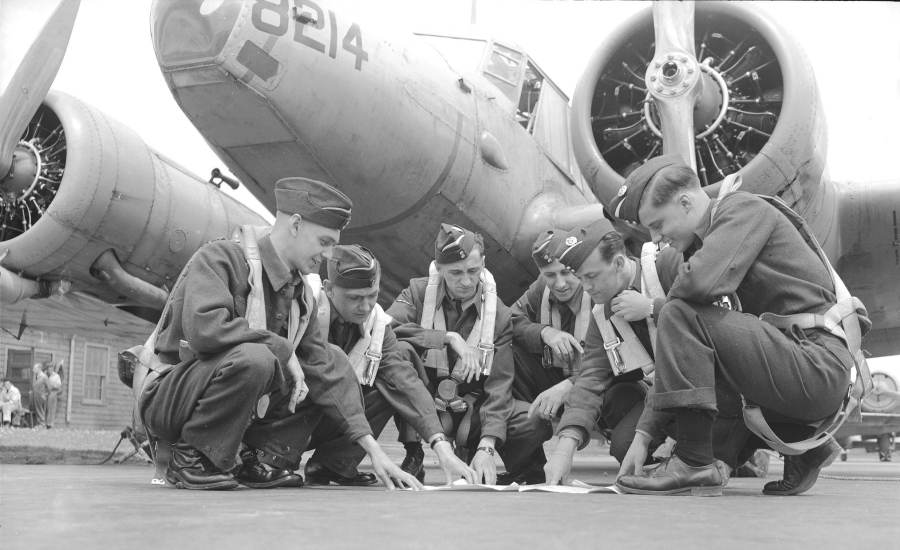
Main photo: Commonwealth airmen study a map before taking off in their Avro Anson on a training flight from RCAF Station Hagersville, Ontario, in May I943. Hagersville was the home of No.16 Service Flying Training School, one of many stations across the country that operated under the BCATP. (Credit: DND Archives)
References
BCATP — Project ’44. 2014. “Project ’44.” Project ’44. 2014. https://www.project44.ca/bcatp.
Canada, Veterans Affairs. 2015. “The British Commonwealth Air Training Plan – Historical Sheet – Second World War – History – Veterans Affairs Canada.” Veterans.gc.ca. 2015. https://veterans.gc.ca/en/remembrance/classroom/fact-sheets/britcom.
The Canadian Encyclopedia. 2006. “British Commonwealth Air Training Plan | the Canadian Encyclopedia.” Thecanadianencyclopedia.ca. February 6, 2006. https://www.thecanadianencyclopedia.ca/en/article/british-commonwealth-air-training-plan.