

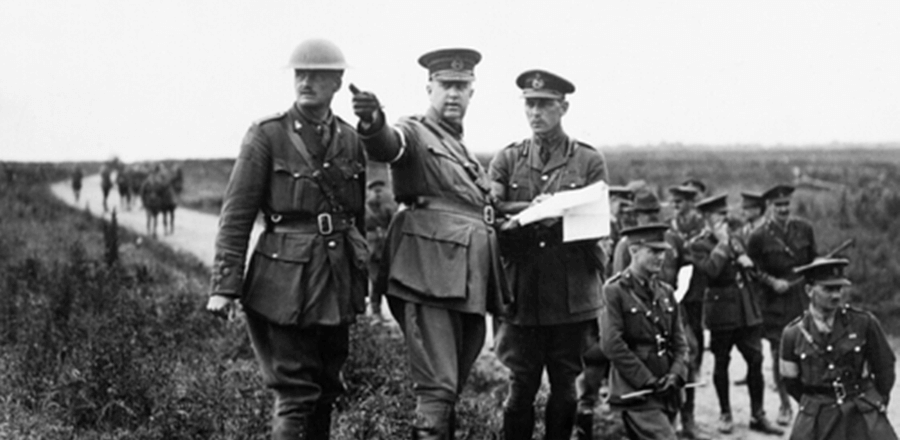
Général Sir Arthur Currie
“…War is simply the curse of butchery, and men who have gone through it, who have seen war stripped of all its trappings, are the last men that will want to see another war…”
- General Arthur Currie, Currie’s Hundred Day Speech to an audience at the Canadian Club in Toronto, ON (August,29, 1919)
Declared by Arthur Currie in 1919, these words came not of a distant politician, but from a man who had lived the through the brutal reality of the First World War. Beneath the gallant valour, medals, and titles, was a Canadian solider who saw war not as glory, but as a grim and costly ordeal. Through tactical brilliance and relentlessness, Arthur Currie led Canada’s forces to some of their most defining victories.
Le général Sir Arthur Currie, né le 5 décembre 1875 à Napperton, en Ontario, deviendra un Canadien monumental pour ses actions pendant la Première Guerre mondiale. Né le 5 décembre 1875, Arthur Currie fut le premier commandant canadien du Corps canadien, succédant à Sir Julian Byng le 9 juin 1917, deux mois après la bataille de la crête de Vimy.
Expérience:
Le général Currie a débuté sa carrière militaire au sein de la Milice canadienne à Victoria, en Colombie-Britannique, où il a perfectionné ses connaissances et ses compétences militaires. Cela jouera plus tard un rôle important dans son succès. Currie n'avait aucune expérience militaire professionnelle lorsqu'il a finalement décidé d'être transféré dans le Corps canadien et a été programmé pour le service actif. Indépendamment de son inexpérience par rapport aux officiers professionnels, Currie reçut le commandement de la 2e brigade d'infanterie en 1914 en raison de ses liens avec l'officier subalterne Garnet Hughes et son père Samuel Hughes, alors ministre canadien de la Milice et de la Défense.
La première expérience de Currie en tant que commandant de troupes au combat eut lieu lors de la deuxième bataille d'Ypres en avril 1915. Son leadership lui valut d'être promu major-général en septembre 1915 et il reçut le commandement de la 1re Division canadienne ; une formation qu'il commande à la Somme et à Vimy avant de prendre le commandement des quatre divisions du célèbre Corps canadien.
Currie n'a jamais perdu une bataille. En tant que commandant le plus haut gradé du Canada, Currie a travaillé sans relâche pour s'assurer que le Corps canadien était bien entraîné et préparé avant de l'engager dans la bataille. Sa planification méticuleuse a conduit le Corps à une série de percées étonnantes lors de la bataille d'Amiens et de laCent derniers joursde la guerre. Currie est reconnu par ses amis et ses ennemis comme l'un des meilleurs commandants opérationnels sur le front occidental pendant la guerre et était particulièrement l'un des favoris du premier ministre britannique Lloyd George. Son palmarès comprendColline 70,Passchendaele,Amiens,Canal du NordetDrocourt-Quéant.
Les historiens canadiens conviennent que le manque de formation militaire formelle de Currie et son expérience dans la milice lui ont permis de se débarrasser d'une doctrine militaire dépassée telle que le « culte de l'offensive » et de combiner l'innovation de style civil avec les valeurs militaires pour former le plus haut type de « professionnalisme militaire par l'expérience et l'expérimentation ».
Le succès des Forces canadiennes sous la direction du général Currie à Vimy a contribué à conférer au Canada une place au sein duNégociations de paix à Versailles. Peut-être plus important encore, la participation de soldats des neuf provinces et territoires sous un seul commandement canadien a contribué à forger l’identité du Canada en tant que nation sûre d’elle et souveraine – et non plus une colonie. C'est le plus grand héritage du général Currie.
Currie se montrerait plus que compétent en tant que leader grâce à sa participation à des conflits tels que leDeuxième bataille d'Ypres,Mont Oseille,la bataille de la Somme, et bien sûr,Crête de Vimy. Le 9 juin 1917, quelques semaines après Vimy, le général Currie est fait chevalier et deviendra le premier soldat né au Canada à commander le Corps canadien ; c'est alors qu'il fut officiellement reconnu comme unMonsieur.
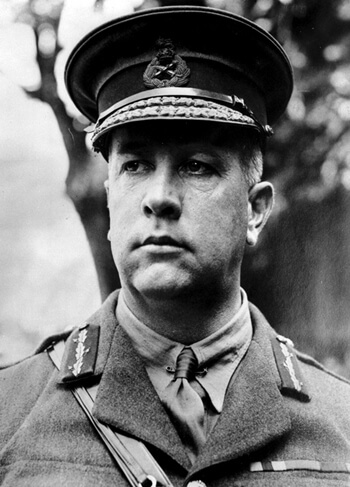
Sir Arthur Currie (Source : Legion Magazine).
Controverse:
C'est à cette époque que le passé de Currie recevrait davantage d'attention. Les histoires abondaient sur Currie, avant la guerre, détournant 10 000 $ pour les fonds du 50e Régiment afin de couvrir une dette personnelle. Sa tromperie s'est rapidement répandue dans les journaux canadiens et, même si le premier ministre Borden n'a pas traduit en cour martiale le légendaire général canadien, il a été contraint de contracter des emprunts pour rembourser sa dette. Un document de recherche (rédigé par le colonel HM Urquhart, DSO) qui fournit des informations supplémentaires sur le détournement de fonds présumé et réfute ces allégations peut être lu.ici.
Tandis que la surveillance politique se poursuivait au Canada, Currie et le Corps canadien remporteraient des victoires acharnées sur la colline 70 et à Passchendaele en 1917. Les deux batailles se révéleraient coûteuses pour les Canadiens ; il était clair que davantage de vies dans l’Entente devraient être sacrifiées pour mettre fin à la guerre. Cependant, les succès constants de Currie se sont avérés une formule gagnante. Le général canadien et le Corps canadien continueront à être victorieux jusqu'en 1918. En fait, les succès continus au cours des derniers mois de la guerre seront considérés par beaucoup comme la plus grande réussite du Canada et de Currie.
Après la guerre, Sir Arthur Currie retourna au Canada où il devint inspecteur général des forces de la milice au Canada et plus tard, principal et vice-chancelier de l'Université McGill, poste que Currie occupa à l'université jusqu'à sa mort en 1933.
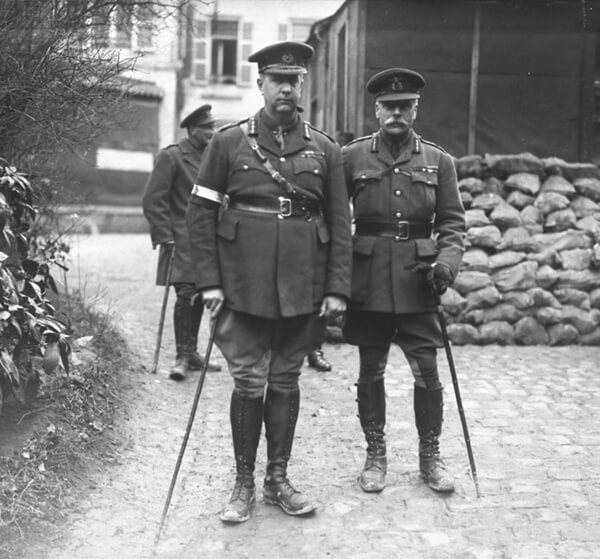
Le général Currie avec le maréchal britannique Sir Douglas Haig (Source : Encyclopédie canadienne).
Pour en savoir plus sur le général Currie et sur la façon dont il voulait « payer » la victoire avec « des obus, pas des vies », visitez notre En route vers VimyByng et Currie page Colline 70 : le plan de Currie, et notre 100 derniers jourspage.
Éducateurs : Cliquez ici pour un plan de leçon qui explore la réputation de Currieou celui-ci quiexplore l'expérience FWW du Canada.Aussi une ressource d'apprentissage plus courte: Feuille de travail Questions et réponses d'Arthur Currie (Taxonomie de Bloom)
Photo principale: Le général Sir Arthur Currie (montrant) avec des officiers lors d'un exercice en septembre 1917 (Crédit : IWM CO1970, mais illustréici).
Sources:
Musée canadien de la guerre. 2019. « Généraux – Sir Arthur Currie | Le Canada et la Première Guerre mondiale. » Le Canada et la Première Guerre mondiale. 2019.https://www.warmuseum.ca/firstworldwar/history/people/generals/sir-arthur-currie/.
Ricketts, Bruce. «Le discours des cent jours de Currie – Canadiens d'armes.» Canadiens en armes, le 25 novembre 2021.https://canadiansatarms.ca/curries-hundred-day-speech/.
« Sir Arthur Currie | L'Encyclopédie canadienne. » et thecanadianencyclopedia.ca.https://thecanadianencyclopedia.ca/fr/article/sir-arthur-currie.